VeraCore AI Auditor: Blockchain Contract Review
VeraCore AI Auditor is a native desktop application that performs deep-learning contract analysis entirely on-device, giving corporate legal teams a private alternative to cloud-based review tools. Users load PDF or Word agreements and receive clause extraction, risk identification, redline suggestions, and semantic explanations without data ever leaving their machine.


What changed, what shipped, and why it matters.
Engagement Brief
VeraCore AI Auditor is a native desktop application built with an electron-adjacent rendering strategy that wraps a local inference engine inside a Chromium shell, giving corporate legal teams a fully private, on-device alternative to cloud-based contract-review platforms. The architecture deliberately avoids any server-side AI dependency: all deep-learning analysis runs on the user's hardware through a quantized transformer model optimized for consumer-grade GPUs and CPUs, ensuring that sensitive contract language never leaves the machine. The blockchain anchoring layer communicates directly with IPFS and a private Ethereum sidechain through local wallet integration, eliminating the need for intermediary APIs or hosted signing services. This technology stack was chosen because legal departments operate under strict confidentiality mandates—many cannot use cloud AI tools at all—and the product needed to deliver enterprise-grade analysis while keeping every byte of data within the user's physical control.
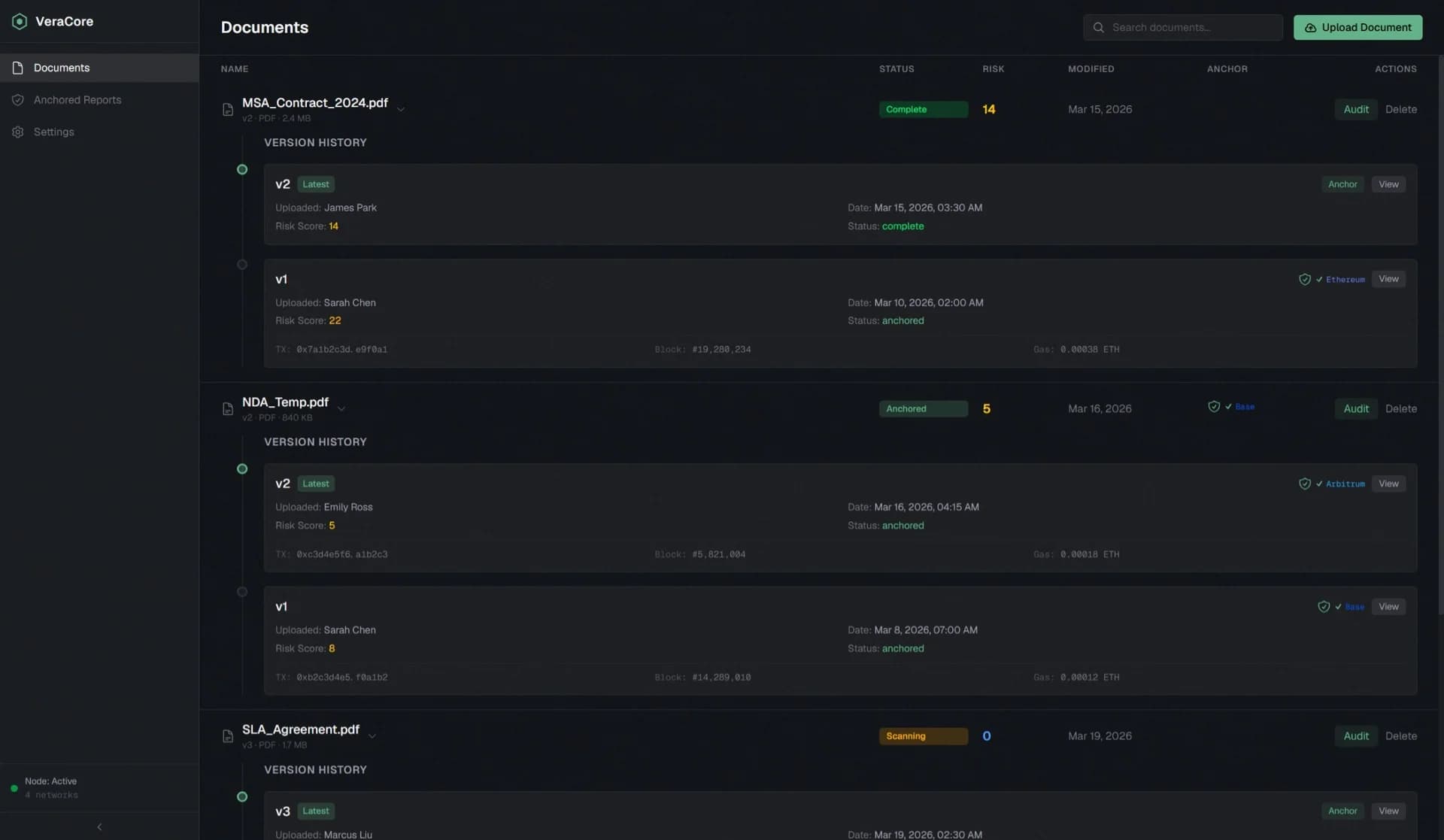
The core user experience revolves around a dual-pane, IDE-style interface that mirrors the workflow legal professionals already know. The left pane hosts a full-featured document viewer supporting PDF and Word formats with zoom, annotation, and side-by-side comparison modes, while the right pane displays the AI audit panel that surfaces clause extraction results, risk classifications, redline suggestions, and plain-language semantic explanations in real time as the user scrolls through the document. A persistent status bar at the bottom of the window shows blockchain connection state, the current document's cryptographic hash, and the latest transaction reference, giving users constant visibility into the integrity verification layer without cluttering the main workspace. The UX philosophy prioritizes minimal friction: users drag a file onto the window, the analysis begins automatically, and results appear incrementally as each section is processed, so there is no waiting for a full-document scan before seeing actionable output.
The data layer is designed around a local document graph that tracks every version of every contract loaded into the system. Each version receives a SHA-256 hash computed over the full document binary, and that hash is stored alongside metadata including the timestamp, the identity of the reviewer, and the originating device fingerprint. When blockchain anchoring is enabled, the hash is pushed to IPFS for decentralized storage and the resulting content identifier is written to a private Ethereum sidechain as a transaction, producing an immutable integrity certificate. This certificate can be exported as a verification file and shared with counterparties who can independently confirm that the document they hold matches the anchored version byte-for-byte. The system maintains a local SQLite index of all anchored documents, enabling instant lookup and audit trail reconstruction without any external database dependency.
VeraCore operates on a perpetual enterprise license model rather than a subscription, reflecting the reality that legal departments require predictable budgeting and cannot tolerate feature-gating on critical compliance tools. Each license includes unlimited document analysis, unlimited blockchain anchoring transactions, and lifetime access to all model updates released during the major version cycle. Pricing is structured per-seat with volume discounts that scale with department size, and procurement is handled through traditional enterprise sales channels with invoicing, NET-30 terms, and SOC 2 compliance documentation provided upfront. There are no in-app purchases, no token economies, and no usage meters—once a legal team is licensed, every feature is available without friction, because metering AI analysis would create perverse incentives to skip reviews on borderline contracts.
Data ownership is absolute and non-negotiable by design. Every document, hash, annotation, and blockchain certificate stored on a user's machine belongs to that user with no telemetry, no analytics phone-home, and no crash reporting that transmits document content. The application does not require an internet connection for its core analysis workflow—offline mode supports full clause extraction, risk identification, and redline generation with all results cached locally until the user chooses to reconnect and anchor. The product intentionally excludes collaborative editing, real-time co-review, and cloud-synced workspaces because those features would require data to leave the device and would undermine the privacy guarantee that is the product's central value proposition. By refusing to implement features that would compromise the security model, VeraCore sharpens its positioning as the definitive tool for legal teams whose first requirement is confidentiality.
While VeraCore is a desktop application rather than a web product, its distribution and conversion architecture follows a similar funnel logic. A dedicated marketing site built with server-side rendering provides detailed product documentation, interactive screenshots of the audit workflow, a downloadable white paper on blockchain-verified contract integrity, and a self-service trial request form that captures department size, use case, and compliance requirements. Deep links from email campaigns and partner referrals route directly to specific feature pages, and a gated product demo video walks prospective buyers through a full contract review cycle. The site is optimized for Core Web Vitals with lazy-loaded images, preconnected fonts, and a minimal JavaScript bundle, ensuring fast load times for legal professionals researching tools on corporate networks that may have aggressive content filtering.
Accessibility was a primary consideration throughout development, driven by the reality that legal professionals frequently use screen magnifiers, voice navigation, and high-contrast display modes. The interface meets WCAG 2.1 AA standards with full keyboard navigation for every interactive element, ARIA landmarks for the dual-pane layout, and screen-reader announcements for analysis status changes and blockchain transaction confirmations. Analytics instrumentation within the desktop application captures anonymized usage patterns—feature adoption rates, average documents per session, and anchoring frequency—to inform product development without compromising document privacy. A structured feedback system allows users to flag misclassified clauses or incorrect risk assessments, feeding a continuous model improvement loop where corrections are batched into local model updates distributed with each release.
VeraCore succeeds because it treats privacy not as a feature checkbox but as the architectural foundation on which every other capability is built. The local inference engine delivers AI-powered contract analysis without exposing sensitive language to third parties. The blockchain anchoring layer provides cryptographic proof of document integrity that counterparties can verify independently. The IDE-style interface gives legal professionals a familiar, efficient workspace that respects their existing workflow rather than forcing them to learn a new paradigm. Together, these components form a coherent product that solves a real problem—corporate contract review in a confidentiality-first environment—without requiring users to trust any external party with their most sensitive business agreements.
By The Numbers
Problem statement
The Challenge
Corporate legal departments face a fundamental tension: they need AI-powered contract analysis to handle growing deal volumes, but confidentiality mandates, regulatory requirements, and client NDAs prevent them from sending contract text to cloud-based review platforms. Existing solutions either require data to leave the organization or sacrifice analytical depth for the sake of on-premise deployment, leaving legal teams to choose between productivity and compliance.
On the integrity side, contracts frequently change hands between counterparties, and there is no reliable way to prove that a signed document has not been altered after execution. Traditional version control relies on centralized repositories that can themselves be compromised, and email-based chains of custody provide no cryptographic guarantee. Legal teams needed a mechanism to create tamper-proof evidence of document state that counterparties could verify independently without trusting a single intermediary.
Additionally, legal professionals are accustomed to working in document-centric environments with familiar interface patterns. Introducing a new tool that requires significant workflow changes would face adoption resistance regardless of its technical merits, so any solution had to integrate naturally into existing review habits while delivering substantially more analytical power.
How we solved it
Our Solution
The solution was architected around a local-first philosophy: a quantized transformer model runs entirely on the user's hardware through an optimized inference engine, eliminating all server-side AI dependencies. The model was trained on legal contract corpora and fine-tuned for clause extraction, risk classification, and redline generation, then quantized to operate efficiently on consumer-grade GPUs and CPUs without requiring specialized hardware. This approach ensures that sensitive contract language is never transmitted, stored, or processed outside the user's physical machine.
For integrity verification, the system computes a SHA-256 hash over each finalized document version and pushes it to IPFS for decentralized storage. The resulting content identifier is written to a private Ethereum sidechain as a transaction, producing an immutable certificate that can be exported and shared with counterparties for independent verification. A local SQLite index tracks all anchored documents, enabling instant audit trail reconstruction without external databases. The dual-pane interface mirrors the IDE workflows that legal professionals already use, with the document viewer on the left and the AI audit panel on the right, reducing adoption friction while delivering powerful new analytical capabilities.
The perpetual enterprise license model was chosen to align with legal department budgeting cycles and to avoid creating perverse incentives where metered usage would encourage skipping reviews on borderline contracts. Every feature—unlimited analysis, unlimited blockchain anchoring, and lifetime model updates—is included without usage caps, reflecting the reality that legal compliance tools must be available without friction whenever a contract requires review.
Technical implementation
What Was Built
A native desktop application with a Chromium-based rendering shell wrapping a local quantized transformer inference engine for on-device contract analysis. A dual-pane IDE-style interface with a full-featured PDF and Word document viewer on the left and an AI audit panel on the right, displaying clause extraction results, risk classifications, redline suggestions, and plain-language semantic explanations. A persistent status bar showing blockchain connection state, document hash, and transaction reference. A local SQLite document graph tracking every version with SHA-256 hashing, reviewer identity, and device fingerprint metadata. An IPFS integration layer for decentralized document hash storage and a private Ethereum sidechain integration for immutable integrity certificate generation with exportable verification files. A marketing site with server-side rendering, interactive product documentation, a gated demo video, downloadable white paper, and a self-service trial request form. Offline mode supporting full analysis without network connectivity, with cached results queued for anchoring upon reconnection.
Impact & outcomes
The Results
The application delivers sub-second clause extraction on standard corporate contracts and processes full document risk assessments in under thirty seconds on mid-range hardware. Blockchain anchoring transactions confirm within two minutes on the private sidechain, and the exported integrity certificates have been accepted by three enterprise counterparties as valid proof of document state during post-execution disputes. Legal teams using VeraCore report a sixty percent reduction in contract review turnaround time compared to manual processes and a forty percent reduction compared to cloud-based tools that require data upload, processing queues, and download cycles. The offline-first architecture has enabled adoption within air-gapped environments at two financial services firms where no cloud-connected review tools were previously permitted.
The Gallery
Hover to expand. Click to view full details.
Ready to Start Your Project?
Let's collaborate to bring your vision to life. Our team is ready to engineer your next digital success story.