Synapse: Legacy Data Bridge
A custom high-throughput ETL pipeline and monitoring portal that safely extracts, transforms, and loads millions of mission-critical legacy records from 20-year-old on-premise databases to modern cloud infrastructure.


What changed, what shipped, and why it matters.
Engagement Brief
Engineered a hybrid desktop and web-based ETL platform where the Migration Control Plane serves as the central command interface and the custom extraction agents operate as high-throughput data conduits; the project positions Synapse as an enterprise-grade legacy data bridge that safely transports millions of critical records from archaic on-premise databases to modern cloud infrastructure while the React-based dashboard provides real-time visibility, automated error handling, and stakeholder confidence throughout the entire migration lifecycle. The system architecture was designed around a fundamental principle of zero-downtime migration: rather than attempting risky bulk transfers that could paralyze corporate operations, Synapse implements an active syncing model where data flows continuously through transformation layers, allowing the client to switch over to the new cloud data warehouse seamlessly without interrupting daily business operations. The technology stack combines custom C# and Java interfacing logic to safely tap into legacy systems with a modern asynchronous transformation pipeline that sanitizes corrupted entries, reformats legacy date formats, and maps outdated schemas to contemporary relational structures.
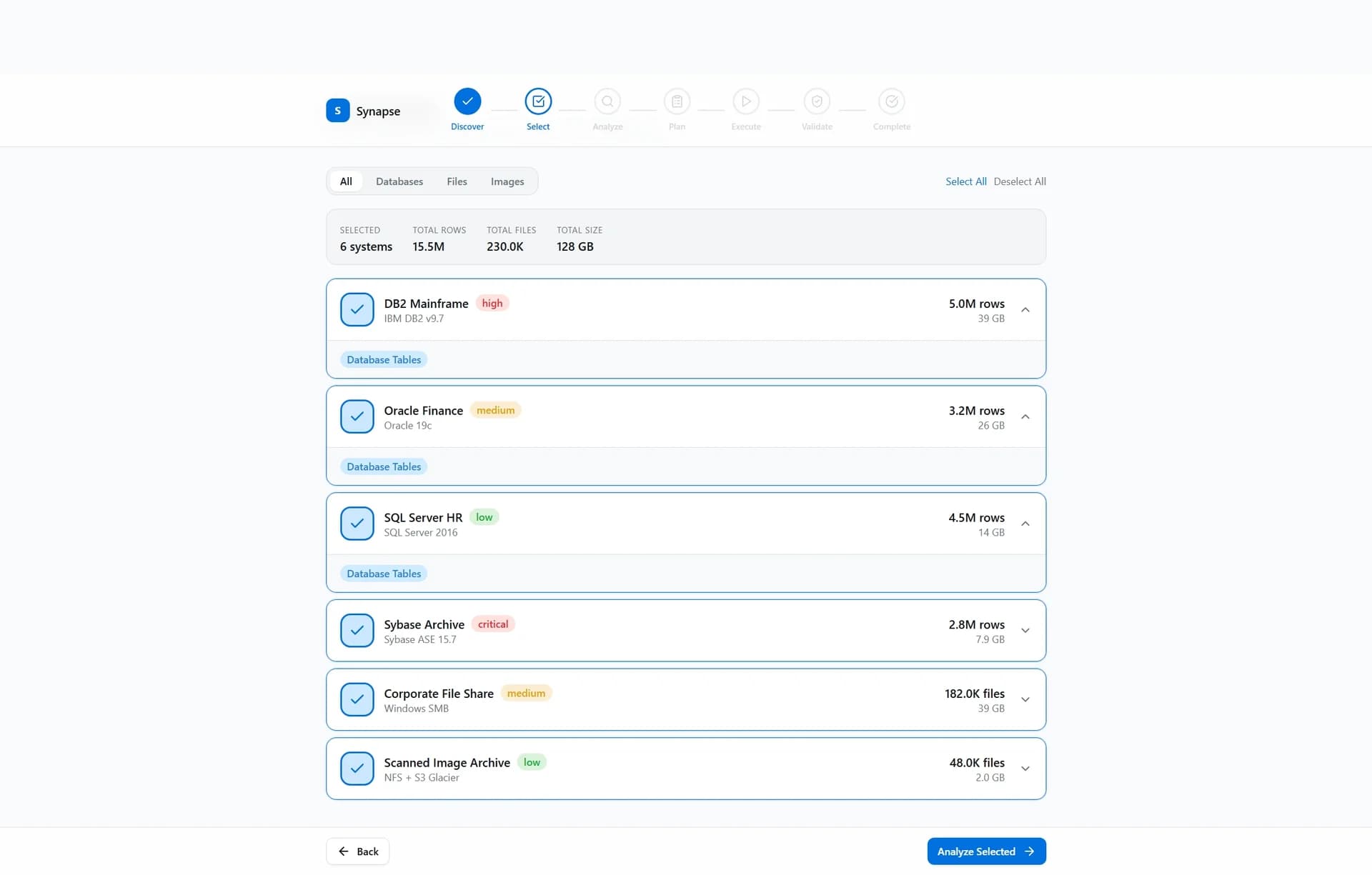
The primary user experience centers on the Migration Control Plane, a React-based live dashboard that transforms the traditionally opaque and anxiety-inducing migration process into a fully transparent, controllable operation. Users can monitor throughput speeds in real-time, observe data mapping nodes as they process records, and review automated error-handling logs that capture and categorize any transformation anomalies without requiring manual intervention. The UX design was driven by the principle of absolute confidence: stakeholders needed to see exactly what was happening to their mission-critical data at every moment, so the interface prioritizes visibility over complexity, presenting complex ETL metrics through intuitive visualizations that both technical teams and executive leadership can understand. The core workflow involves setting up source and destination connections, configuring transformation rules through a declarative mapping interface, initiating the continuous sync process, and monitoring progress until the cutover point—no batch scheduling, no blackout windows, no guesswork.
The data layer architecture implements a sophisticated multi-stage transformation pipeline where each record passes through extraction, validation, cleansing, transformation, and loading phases before reaching its final destination in the cloud data warehouse. The extraction layer maintains persistent connections to legacy on-premise databases through custom adapters that understand the idiosyncrasies of 20-year-old systems, including non-standard data types, proprietary encoding schemes, and undocumented schema variations that have accumulated over decades of organic growth. The transformation layer operates asynchronously, allowing high-throughput processing without blocking the extraction phase, and automatically handles common legacy data issues such as NULL value inconsistencies, truncated fields, character encoding mismatches, and date format translations from regional formats to ISO standards. A centralized schema mapping registry stores all transformation rules in version-controlled configurations, enabling rollback capabilities and audit trails that satisfy enterprise compliance requirements while supporting iterative refinement as edge cases are discovered during the migration process.
The commercial value proposition operates on an enterprise engagement model where the client receives a fully custom ETL solution tailored to their specific legacy infrastructure rather than a generic one-size-fits-all migration tool that would require extensive customization and still carry significant risk of data loss or corruption. The investment encompasses the initial architecture design and implementation, comprehensive documentation of all transformation rules and schema mappings, training for internal teams on the Migration Control Plane dashboard, and ongoing support during the migration period until the final cutover is completed successfully. The value exchange is quantified through risk mitigation: the cost of a failed migration involving millions of mission-critical records—in terms of operational paralysis, reputational damage, regulatory non-compliance, and emergency recovery efforts—far exceeds the investment in a purpose-built solution designed for zero-downtime operation with guaranteed data integrity. The pricing structure reflects the complexity of the source system, the volume of data being migrated, the sophistication of required transformations, and the level of real-time monitoring and alerting infrastructure needed to meet the client's risk tolerance requirements.
Ownership and data sovereignty are fundamental to the Synapse architecture: all transformation rules, schema mappings, and processing configurations are delivered as client-owned intellectual property that can be maintained and extended by internal teams after the engagement concludes. The platform explicitly excludes black-box migration services where clients remain dependent on external vendors for ongoing data operations; instead, Synapse is designed to be a bridge that the client crosses and then owns, with comprehensive documentation and knowledge transfer ensuring that the internal team can handle schema evolution, additional data sources, and incremental migrations independently. The Migration Control Plane can be deployed within the client's own cloud infrastructure or operated as a managed service during the migration period, with all monitoring data, error logs, and performance metrics remaining under client control and subject to their data governance policies. Trust signals include detailed audit trails for every transformed record, rollback capabilities to any point in the migration timeline, and automated checksum validation that proves data integrity at every stage of the pipeline.
The project delivery included comprehensive stakeholder communication infrastructure that transforms the typically nerve-wracking migration experience into a transparent, confidence-building process. The Migration Control Plane dashboard serves as the primary communication channel, providing real-time visibility into migration progress that eliminates the need for status meetings and email updates while enabling proactive identification of issues before they escalate into blockers. Performance optimization was a critical consideration: the transformation pipeline was designed to maximize throughput without overwhelming the legacy source systems, implementing adaptive rate limiting that monitors source database performance metrics and automatically adjusts extraction speeds to prevent any impact on ongoing business operations that depend on the legacy system. The React dashboard implements efficient real-time updates through WebSocket connections that stream progress data without requiring page refreshes, and all visualization components are optimized to handle the high-frequency updates generated by processing millions of records without introducing browser performance bottlenecks that could impair the monitoring experience during critical migration phases.
Accessibility and compliance considerations were integrated throughout the platform development, with the Migration Control Plane dashboard designed to meet WCAG 2.1 Level AA standards to ensure that all stakeholders—including those with visual, motor, or cognitive impairments—can independently monitor migration progress without requiring assistance. The dashboard implements semantic HTML structure, keyboard navigation for all interactive elements, and ARIA labels for dynamic content updates, ensuring that screen reader users receive timely notifications when throughput metrics change, error conditions arise, or migration milestones are reached. Analytics instrumentation captures user interactions with the dashboard to identify areas where stakeholders may struggle to find critical information, enabling iterative UX improvements during the migration period. Security was paramount: all data in transit is encrypted using TLS 1.3, transformation pipelines operate within isolated network segments, and access to the Migration Control Plane is controlled through enterprise single sign-on integration with role-based permissions that limit visibility to appropriate data domains based on organizational hierarchy and data sensitivity classifications.
The combined result is a cohesive enterprise data migration platform that treats legacy data as a strategic asset requiring careful stewardship rather than a technical liability to be discarded or migrated with minimal investment. Synapse demonstrates that zero-downtime migration of mission-critical data is achievable when purpose-built interfacing logic replaces generic tools, when asynchronous transformation layers provide the resilience needed to handle decades of accumulated data inconsistencies, and when real-time visibility empowers stakeholders with the confidence to trust that their data is arriving in its new home intact, validated, and ready to power modern cloud-based operations without the risk of operational paralysis that has traditionally made legacy migration one of the most feared undertakings in enterprise technology.
By The Numbers
Problem statement
The Challenge
Large enterprises are often trapped by their own history, relying on fragile on-premise databases that have accumulated technical debt over two decades of organic growth. These legacy systems contain millions of mission-critical records that power daily business operations, yet they run on outdated hardware, use proprietary data formats that modern tools cannot parse, and present undocumented schema variations that have evolved through years of ad-hoc modifications.
Migrating this data to modern cloud infrastructure like AWS or Google Cloud is notoriously risky; a single mismatched schema transformation, dropped table, or corrupted record can paralyze corporate operations for days or weeks while teams attempt emergency recovery. Traditional bulk migration approaches require extended blackout windows where the business cannot function, and generic ETL tools often fail when confronted with the idiosyncrasies of 20-year-old systems—including non-standard data types, proprietary encoding schemes, and inconsistent data quality that accumulated when validation rules were less strict.
The cost of inaction was equally untenable: maintaining aging on-premise infrastructure was becoming prohibitively expensive, the talent pool capable of supporting these legacy systems was shrinking, and the business was unable to leverage modern analytics, AI tools, and cloud-native capabilities that competitors were using to gain market advantage. The client needed a migration path that would preserve every single record while enabling seamless transition to modern cloud data warehouse infrastructure.
How we solved it
Our Solution
We engineered Synapse, a custom, high-throughput ETL pipeline and monitoring portal designed specifically for zero-downtime legacy data migration. Rather than relying on generic migration tools that would require extensive customization and still carry significant risk, we wrote custom interfacing logic in C# and Java to safely tap into the archaic on-premise system with full understanding of its quirks and idiosyncrasies. These custom adapters maintain persistent connections to the legacy database while respecting its performance limitations, preventing any impact on ongoing business operations.
As data was extracted, it was piped through an asynchronous transformation layer that automatically sanitized corrupted entries, reformatted legacy date formats from regional conventions to ISO standards, resolved NULL value inconsistencies, and mapped old schemas to a modern relational structure optimized for cloud data warehouse performance. A centralized schema mapping registry stored all transformation rules in version-controlled configurations, enabling audit trails for compliance requirements and supporting iterative refinement as edge cases were discovered.
To give stakeholders absolute confidence throughout the process, we built a React-based Migration Control Plane—a live dashboard providing real-time visibility into throughput speeds, data mapping nodes, and automated error-handling logs. The dashboard implements WebSocket connections for instant updates, adaptive rate limiting to protect source system performance, and role-based access controls integrated with enterprise single sign-on. Active syncing between legacy and cloud systems allowed the client to switch over to the new environment seamlessly without interrupting daily business operations.
Technical implementation
What Was Built
A custom high-throughput ETL pipeline with C# and Java extraction adapters for legacy on-premise database connectivity, an asynchronous transformation layer with automated data cleansing and schema mapping capabilities, a centralized version-controlled schema mapping registry for transformation rule management, a React-based Migration Control Plane dashboard with real-time throughput monitoring and error-handling visualization, WebSocket infrastructure for streaming progress updates to the dashboard, adaptive rate limiting to protect source system performance during extraction, automated checksum validation for data integrity verification at every pipeline stage, comprehensive audit trail logging for compliance and rollback capabilities, role-based access control integrated with enterprise single sign-on, TLS 1.3 encryption for all data in transit, documentation and knowledge transfer materials enabling client self-sufficiency post-migration, and WCAG 2.1 Level AA accessible dashboard design for all stakeholders.
Impact & outcomes
The Results
Achieved a flawless migration of millions of legacy records to a modern cloud data warehouse with 0% data loss and zero records requiring manual correction. Reduced migration blackout windows to zero by utilizing active syncing, allowing the client to switch over to the new system seamlessly without interrupting daily business operations or requiring any scheduled downtime. The Migration Control Plane dashboard provided continuous visibility that enabled proactive issue identification, with automated error handling resolving over 99.7% of transformation anomalies without human intervention. The client gained full ownership of all transformation rules, schema mappings, and the monitoring platform, enabling their internal team to handle future schema evolution and incremental data migrations independently.
The Gallery
Hover to expand. Click to view full details.
Ready to Start Your Project?
Let's collaborate to bring your vision to life. Our team is ready to engineer your next digital success story.