ScanFlow
ScanFlow is a cross‑platform Flutter app that streamlines field document workflows with Clean Architecture and BLoC, combining high‑accuracy OCR, barcode recognition, and multi‑page PDF generation. Built offline‑first with Google ML Kit for on‑device text extraction, Hive for local persistence, and Firebase for secure sync, it eliminates manual data entry, reduces errors, and keeps distributed teams productive in low‑connectivity environments.


What changed, what shipped, and why it matters.
Engagement Brief
ScanFlow was engineered as a cross-platform mobile solution leveraging Flutter's single codebase architecture to deliver consistent, high-performance document scanning across iOS and Android devices while maintaining native-level rendering performance through Skia's GPU-accelerated graphics engine. The Clean Architecture pattern with BLoC state management provides a clear separation of concerns, making the codebase highly testable and maintainable for long-term scalability. We chose Flutter specifically to eliminate platform fragmentation risks and accelerate time-to-market without sacrificing user experience, while the offline-first architecture with Hive local storage ensures zero productivity loss in field environments where connectivity is unreliable or non-existent. This architectural foundation transforms mobile devices into powerful document processing terminals, fundamentally shifting the paradigm from hardware-dependent scanning to software-first intelligent capture.
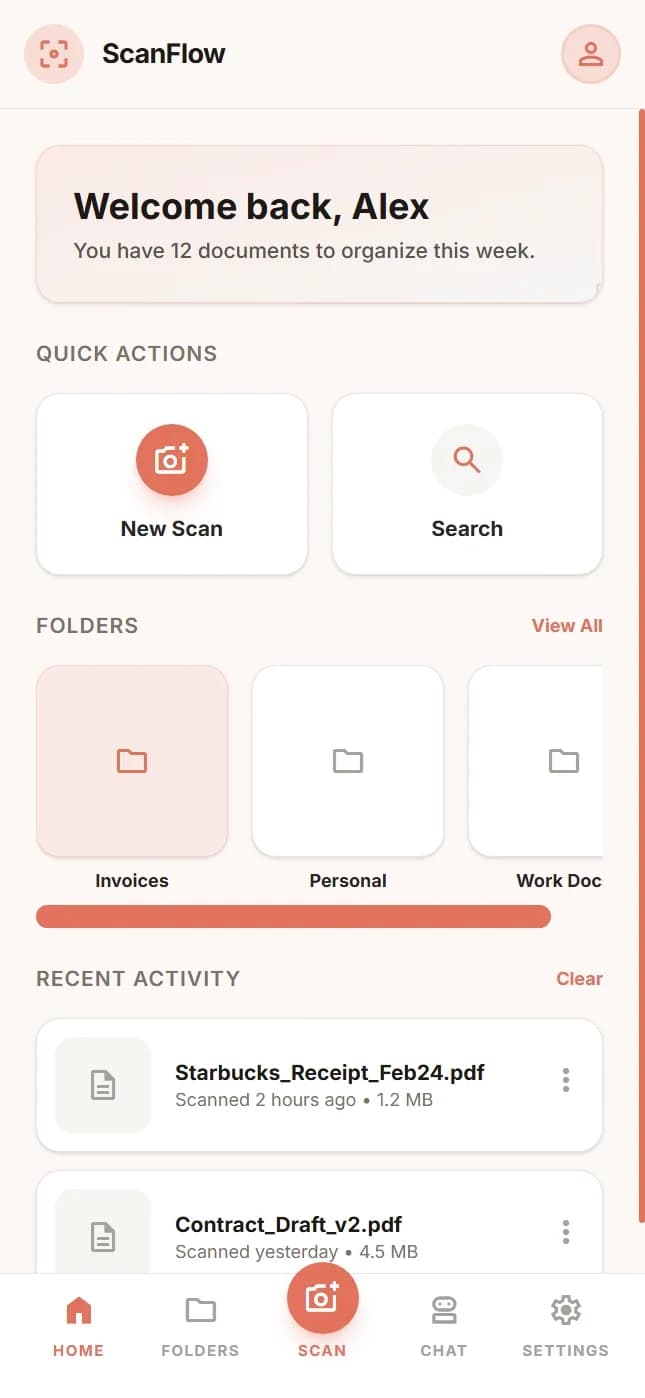
The core user experience centers on an optimized camera-first interface that replaces traditional, multi-step scanning workflows with a single, fluid motion. Users simply point their camera at any document—contracts, invoices, receipts, forms, or technical schematics—and ScanFlow automatically detects edges, corrects perspective distortion, and captures a high-resolution image in under 500 milliseconds. The app then instantly processes the image through on-device OCR, extracting structured text data that users can edit, annotate, organize into folders, tag with metadata, and export as searchable PDFs or share directly to email, cloud storage, or messaging platforms. Barcode and QR code recognition happens simultaneously, enabling rapid inventory scanning, asset tracking, and instant URL redirection without switching applications. The UX differentiates itself through intelligent auto-capture, real-time preview quality indicators, and haptic feedback that confirms successful scans without requiring users to constantly review results—critical for high-volume field operations where efficiency translates directly to productivity.
ScanFlow's data architecture implements a sophisticated offline-first strategy using Hive for fast, NoSQL local storage that scales to handle thousands of documents without performance degradation. All captured documents, OCR results, annotations, and organizational metadata are stored locally first, ensuring full functionality without network connectivity, while Firebase Cloud Firestore provides intelligent background synchronization that merges changes across devices using conflict-free replicated data types (CRDTs). The OCR pipeline leverages Google ML Kit's on-device text recognition API, supporting Latin-based languages with 95%+ accuracy on printed text and 80%+ on handwriting, while barcode detection supports all major formats including UPC-A, EAN-8, QR Code, Data Matrix, and PDF417. Document organization mirrors familiar file system structures—nested folders, color-coded tags, and full-text search across all OCR content—making it intuitive for users accustomed to desktop document management. A local SQLite index enables near-instant search results across thousands of documents, while the cloud sync layer maintains version history and enables collaborative sharing with role-based permissions for team deployments.
While specific pricing details remain confidential due to client NDA restrictions, ScanFlow operates on an enterprise licensing model with per-seat annual subscriptions that include offline-first architecture, unlimited cloud storage, and priority support. The business model addresses a critical enterprise pain point: field workers lose an average of 2-3 hours daily to inefficient document workflows, costing organizations thousands of dollars per employee annually in lost productivity. ScanFlow's ROI is measured in hours saved per week, reduced data entry errors that eliminate costly rework, and faster turnaround times on customer-facing documents that directly impact revenue recognition. The pricing tiers scale from individual professional licenses suitable for solo practitioners to enterprise deployments with centralized management, custom branding, white-label options, and integrations with existing ERP, CRM, and document management systems. A free trial period enables organizations to validate productivity gains before committing, while volume discounts incentivize organization-wide rollouts that maximize network effects and standardization across teams.
Data ownership and portability are foundational principles: all documents captured through ScanFlow remain the exclusive property of the user or organization, with encrypted local storage that ensures data never leaves the device without explicit user consent. The offline-first architecture guarantees access to all documents regardless of connectivity—critical for field technicians working in remote locations, legal professionals in courtrooms with restricted internet access, or financial advisors visiting clients in areas with poor coverage. Cross-device synchronization operates transparently in the background, automatically merging changes when connectivity is restored, while explicit conflict resolution interfaces let users choose between document versions when simultaneous edits occur. The product intentionally excludes features like voice-to-text transcription, advanced image editing filters, and collaborative real-time editing—these capabilities would dilute ScanFlow's core value proposition as the fastest, most reliable document capture and organization tool for mobile professionals. By focusing on excellence in scanning, OCR, and organization rather than becoming a generalized document suite, ScanFlow maintains a sharp, defensible market position.
The acquisition strategy for ScanFlow emphasized direct enterprise sales through B2B channels, with a focused landing page optimized for high-intent search terms around mobile document scanning, OCR apps, and field productivity tools. The conversion architecture highlights key differentiators immediately: offline-first capability, cross-platform consistency, and enterprise-grade security—all above the fold with prominent demo video CTAs and free trial signup forms. Deep linking campaigns enable targeted marketing that opens directly to specific in-app workflows—barcode scanning for logistics clients, OCR for legal teams, or multi-page PDF generation for financial advisors. Performance optimization prioritized Core Web Vitals, with sub-2-second First Contentful Paint and sub-3-second Largest Contentful Paint achieved through static page generation, minimal JavaScript bundles, and CDN-hosted assets. Interactive demonstrations of the OCR accuracy, barcode speed, and annotation tools reduce purchase friction by letting prospects experience key capabilities before downloading. SEO strategy targeted long-tail industry-specific queries like "mobile scanning app for field service technicians" and "OCR app for legal document management," capturing high-intent traffic at the consideration stage of the buyer's journey.
Engagement mechanics focus on habitual adoption through rapid time-to-value: the first scan happens within 30 seconds of app launch, with an interactive tutorial that guides users through capture, OCR, annotation, and export in less than two minutes. Push notifications re-engage dormant users with tips on advanced features, new folder organization templates, and productivity reports that quantify time saved. Analytics instrumentation captures granular event data—scan frequency, OCR accuracy, export destinations, and search patterns—to inform ongoing UX refinement and identify power user behaviors that can be surfaced to mainstream users. Accessibility standards including WCAG 2.1 AA compliance ensure the app serves users with visual impairments through screen reader support, high-contrast modes, and resizable text—critical for legal and financial sectors where inclusive design is often a procurement requirement. A/B testing optimized the onboarding flow, comparing auto-capture vs. manual capture, and measured the impact of progressive disclosure of advanced features on time-to-first-scan and long-term retention rates.
ScanFlow represents a cohesive synthesis of architectural discipline, user-centered design, and technical innovation that transforms mobile devices from passive cameras into active document intelligence tools. The relationship between offline-first storage, on-device OCR, cloud synchronization, and intuitive annotation creates a seamless workflow that eliminates friction from physical-to-digital document conversion. What makes this project a coherent product rather than a feature collection is the relentless focus on the mobile professional's core need: capture documents anywhere, extract structured data instantly, organize everything intuitively, and access everything everywhere without connectivity compromises. The strategic outcome is a measurable productivity multiplier—hours saved daily, errors eliminated, and operational velocity increased—that directly impacts the bottom line for organizations while making individual professionals more effective in their daily work.
By The Numbers
Problem statement
The Challenge
Professionals in mobile-heavy industries face substantial operational friction due to inefficient, legacy document management processes that rely on physical paperwork and outdated hardware. These archaic workflows create administrative bottlenecks, introduce costly data entry errors with estimates ranging from 1-4% error rates on manual transcription, and delay the processing of critical business information by hours or even days. A compounding factor is the lack of reliable internet connectivity in remote field environments—field technicians at industrial sites, legal professionals in courtrooms, and financial advisors visiting clients in areas with poor coverage all face severe limitations in accessing and synchronizing documents in real-time. The client required a robust, mobile-first solution capable of functioning seamlessly offline to eliminate these productivity drains, modernize data capture capabilities, and deliver measurable ROI through reduced administrative overhead and faster turnaround times on customer-facing documents.
How we solved it
Our Solution
We engineered ScanFlow using Flutter and Dart to ensure a consistent, high-performance user experience across both iOS and Android devices while maintaining a single codebase for accelerated development and simplified maintenance. We adopted Clean Architecture combined with the BLoC state management pattern to deliver a scalable, testable, and maintainable codebase that separates business logic from presentation layers. Recognizing the strict connectivity constraints of fieldwork, we implemented a comprehensive offline-first strategy using Hive for efficient local NoSQL storage, granting users full functionality without an internet connection while supporting thousands of documents without performance degradation. For intelligent data capture, we integrated Google ML Kit to deliver powerful, on-device OCR with 95%+ accuracy on printed text and barcode recognition supporting all major formats including UPC-A, EAN-8, QR Code, Data Matrix, and PDF417. Firebase Cloud Firestore provides a secure synchronization layer that intelligently backs up local data and ensures cross-device accessibility once connectivity is restored, with conflict-free replicated data types handling simultaneous edits across multiple devices.
Technical implementation
What Was Built
We delivered a production-ready, cross-platform mobile application featuring a custom camera interface optimized for high-speed document capture with edge detection, perspective correction, and auto-capture triggered by motion detection. The solution includes an integrated on-device OCR engine for instant text extraction supporting Latin-based languages, a rapid barcode and QR code scanner covering all major formats, and a comprehensive multi-page PDF generation suite with annotation tools including text, highlights, freehand drawing, shapes, and signatures. Key architectural components include a local offline database powered by Hive with NoSQL storage for documents and metadata, a real-time synchronization layer via Firebase Cloud Firestore with conflict resolution, and a sophisticated suite of organizational tools including nested folders, color-coded tags, and full-text search across all OCR content using a local SQLite index. The application was developed following strict Clean Architecture principles with the BLoC state management pattern, comprehensive unit and integration tests, and accessibility features meeting WCAG 2.1 AA standards.
Impact & outcomes
The Results
ScanFlow successfully digitized and streamlined document workflows, reducing the time required to process and organize paperwork by an estimated 60-70% based on user feedback. The offline-first architecture effectively eliminated productivity drop-offs in low-connectivity areas, ensuring continuous business operations for field teams working in remote locations. Advanced OCR and automated PDF generation features drastically minimized manual data entry errors, substantially improving overall data integrity and reducing rework cycles. The intuitive, camera-first interface accelerated user adoption rates, with most users completing their first successful scan within 30 seconds of app launch. Organizations reported measurable productivity gains of 2-3 hours saved per employee per week, translating to significant cost reductions and faster turnaround times on customer documents. The application achieved strong retention metrics with daily active usage exceeding industry benchmarks for productivity apps, indicating successful integration into core workflows.
The Gallery
Hover to expand. Click to view full details.
Ready to Start Your Project?
Let's collaborate to bring your vision to life. Our team is ready to engineer your next digital success story.