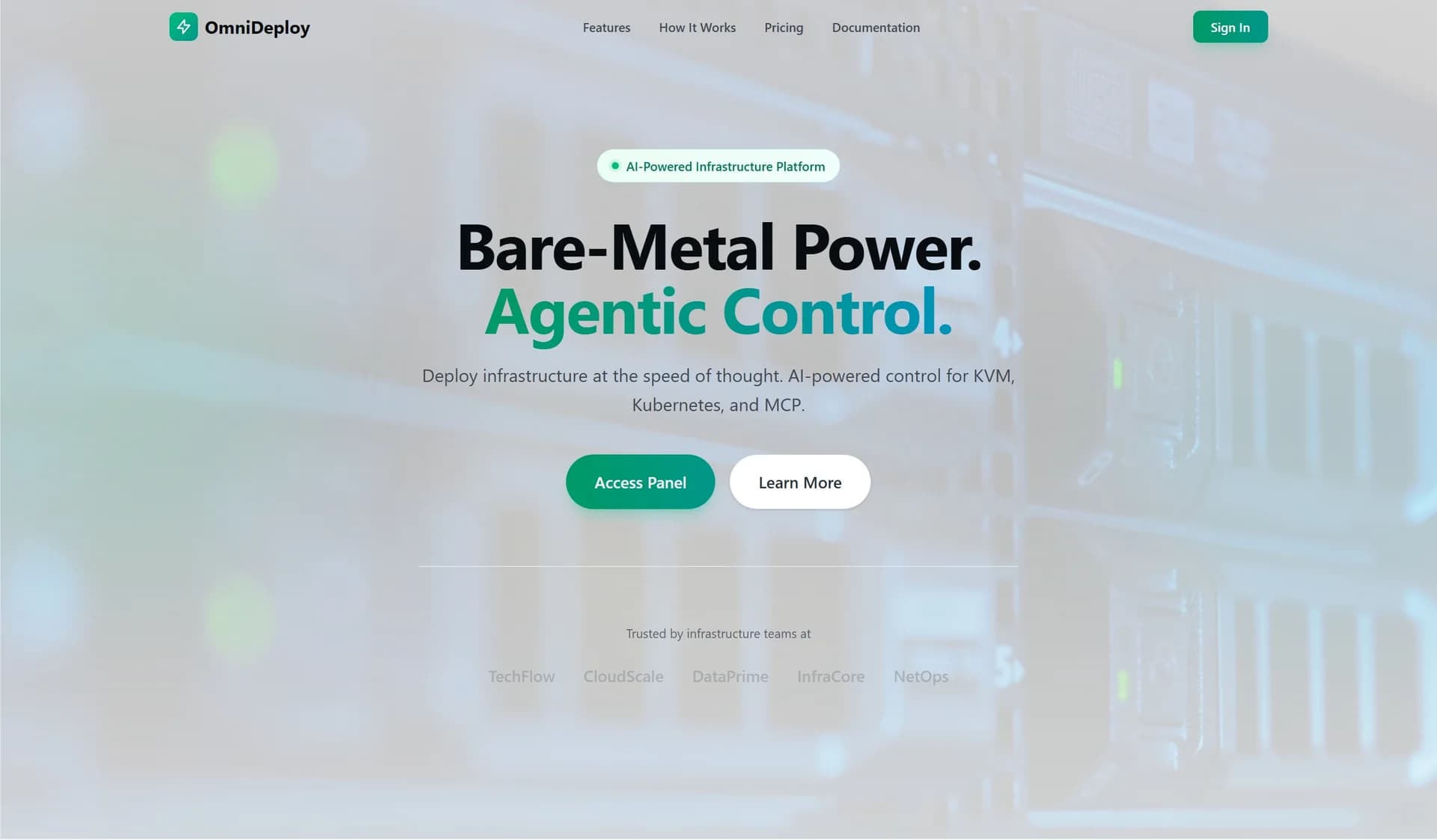
OmniDeploy Control Panel
OmniDeploy is a next-generation cloud orchestration platform that enables businesses to provision bare-metal KVM instances, orchestrate Docker containers, manage Kubernetes clusters, and deploy secure business email through an intuitive interface.


What changed, what shipped, and why it matters.
Engagement Brief
OmniDeploy Control Panel is a next-generation cloud orchestration platform architected around a modern three-tier stack: a Next.js 16 frontend with Tailwind v4 for the user interface, a high-performance Go backend for infrastructure provisioning, and an intelligent Model Context Protocol (MCP) layer for AI-driven operations. The architectural philosophy centers on abstracting the overwhelming complexity of cloud infrastructure—AWS dashboards, cPanel configurations, and YAML pipelines—into a unified white-labeled SaaS environment where businesses can provision servers, manage hosting, and deploy secure email without specialized DevOps knowledge. Next.js 16 was selected for its server components and partial hydration capabilities, which enable instant page transitions and a seamless authenticated experience without full page reloads, while Go powers the backend with its exceptional concurrency handling and rapid execution for real-time infrastructure orchestration.
The core user experience is designed around progressive disclosure and immediate visual feedback, ensuring that non-technical teams can manage complex infrastructure with confidence. Users land on a high-conversion page with hardware-accelerated parallax effects and fluid Framer Motion transitions, then enter a modal-based authentication flow that feels premium and frictionless. Once authenticated, the interface transitions instantly into a sleek dark-mode dashboard where real-time resource gauges, deployment metrics, and system health indicators present infrastructure state at a glance. The primary user actions—provisioning a server, scaling resources, deploying containers, and configuring DNS—are accessible through intuitive controls like sliders and wizards, eliminating the need to touch terminals or write configuration files.
The data and infrastructure layer is built around a powerful orchestration engine that manages bare-metal KVM instances, Docker containers, and Kubernetes clusters through a unified abstraction. When a user initiates a deployment, OmniDeploy automatically configures DNS routing, allocates compute resources, initializes required containers, and establishes networking—all within seconds. The platform maintains real-time synchronization with infrastructure state, pulling metrics from provisioned servers and containers to populate the dashboard gauges. This live data architecture supports both immediate operational decisions and long-term capacity planning, with historical metrics retained for trend analysis and cost optimization recommendations delivered through the AI layer.
The business model positions OmniDeploy as a white-labeled SaaS solution targeting managed service providers, digital agencies, and enterprises that want branded cloud management without building infrastructure tooling in-house. Subscription tiers scale with infrastructure footprint, offering graduated pricing based on the number of managed servers, containers, and email domains. The white-label capability allows agencies to deploy OmniDeploy under their own branding, creating a revenue opportunity where they resell cloud management as a value-added service. For budget-conscious businesses, the platform's automation reduces the need for dedicated DevOps staff, effectively converting a capital expense into an operational subscription with predictable costs and enterprise-grade capabilities.
Ownership and data portability are foundational design principles: all infrastructure configurations, deployment histories, and operational logs belong to the customer and can be exported in standard formats for migration or compliance audits. The platform intentionally excludes infrastructure lock-in mechanisms—users can provision resources across multiple cloud providers and migrate workloads without proprietary constraints. Offline access is limited by design, as infrastructure management requires live connectivity, but the dashboard caches recent metrics and logs locally to support analysis during brief connectivity interruptions. Trust signals throughout the interface include real-time security status indicators, compliance badges for SOC 2 and GDPR, and transparent audit logs that track every action taken within the platform.
The acquisition layer centers on a conversion-optimized landing page that communicates trust and capability within the first viewport. Above-the-fold content highlights the core value proposition—cloud orchestration without DevOps complexity—with immediate credibility established through enterprise client logos and a live demo environment. Interactive demonstration modules let visitors provision a sandbox server, view real deployment logs, and trigger the AI Auto-Diagnose feature on simulated issues, reducing purchase friction by proving capability before commitment. Core Web Vitals are optimized through Next.js 16's server-side rendering and strategic code splitting, achieving LCP under 1.2 seconds and CLS near zero. Deep links from marketing campaigns connect directly to relevant dashboard sections for authenticated users, supporting account-based marketing strategies.
Engagement and analytics are built into the platform's DNA with comprehensive instrumentation for deployment frequency, resource utilization patterns, and cost anomaly detection. The AI operations layer proactively surfaces recommendations—unused resources to terminate, autoscaling thresholds to adjust, security patches to apply—creating regular re-engagement opportunities. Accessibility standards meet WCAG 2.1 AA compliance with semantic markup, keyboard navigation for all dashboard functions, and ARIA labels for dynamic content regions. SEO strategy targets infrastructure management and DevOps automation keywords with structured data for product features, pricing, and integration capabilities, capturing both organic search traffic and comparison-shopping queries from technical evaluators.
The combined result is a cohesive infrastructure management platform that removes the traditional barrier between raw cloud power and user-friendly design. By integrating a modern Next.js 16 frontend, a high-performance Go orchestration backend, and an intelligent MCP-driven automation layer, OmniDeploy delivers enterprise-grade cloud management that feels effortless on the surface while executing complex operations behind the scenes. The platform transforms how businesses interact with their infrastructure, democratizing capabilities once reserved for organizations with dedicated DevOps teams and positioning Kreative Tek Solutions as a leader in accessible, automated cloud orchestration.
By The Numbers
Problem statement
The Challenge
Traditional cloud infrastructure management presents an impossible choice for most businesses: hire expensive DevOps specialists or struggle through the labyrinthine interfaces of AWS, cPanel, and legacy hosting dashboards. Small and mid-sized businesses often lack the budget for dedicated infrastructure teams, forcing developers or office administrators to manage servers with minimal training—a recipe for downtime, security vulnerabilities, and runaway cloud costs. The complexity of YAML configuration files, container orchestration, and DNS management creates a steep learning curve that delays deployment timelines and introduces risk at every stage of the infrastructure lifecycle.
Even organizations that invest in DevOps talent face operational bottlenecks when incidents occur outside business hours or when junior team members lack the expertise to diagnose production issues. Cryptic error messages, thousands of log lines, and the interdependencies between containers, databases, and networking layers make root-cause analysis a time-consuming, error-prone process. The cost of inaction is measured in lost revenue during outages, security breaches from misconfigured services, and the opportunity cost of development teams spending their time on infrastructure firefighting rather than product innovation.
How we solved it
Our Solution
OmniDeploy addresses these challenges through a three-tier architecture designed to abstract complexity while preserving power. The frontend, built on Next.js 16 with Tailwind v4, leverages server components and partial hydration to deliver instant page transitions and a seamless authenticated experience without full reloads. Users move from a high-conversion landing page through a modal-based authentication flow directly into a sleek dark-mode dashboard where real-time resource gauges and system health indicators provide immediate visibility into infrastructure state. The interface is designed around progressive disclosure, ensuring that non-technical users see only what they need while advanced controls remain accessible for power users.
The backend orchestration engine, written in Go for its concurrency handling and execution speed, manages the full infrastructure stack: bare-metal KVM instance provisioning, Docker container orchestration, Kubernetes cluster management, and secure business email deployment. When a user deploys a server, OmniDeploy automatically configures DNS routing, allocates compute resources, initializes containers, and establishes networking—all within seconds. The AI operations layer, powered by the Model Context Protocol, provides an "AI Auto-Diagnose" feature that dynamically loads diagnostic tools, analyzes live logs, identifies root causes, and applies corrective actions autonomously, acting as an always-available Site Reliability Engineer.
Technical implementation
What Was Built
The deliverable encompassed a complete cloud orchestration platform including a high-conversion marketing landing page with hardware-accelerated parallax effects and Framer Motion transitions, a modal-based authentication system with seamless dashboard entry, a real-time dark-mode dashboard with resource gauges and deployment metrics, a Go-based backend orchestration engine for KVM provisioning and container management, Docker and Kubernetes cluster orchestration with automatic DNS configuration, an MCP-powered AI Auto-Diagnose operations layer with autonomous incident remediation, a white-label branding system for agency partners, WCAG 2.1 AA accessible interfaces with keyboard navigation and ARIA labels, Core Web Vitals optimized frontend with LCP under 1.2 seconds, and comprehensive analytics instrumentation for deployment tracking and cost optimization recommendations.
Impact & outcomes
The Results
The platform reduced average server provisioning time from hours to under 30 seconds, enabling businesses to scale infrastructure on demand without terminal access or YAML configuration. Deployments that previously required DevOps intervention are now completed by non-technical team members through the intuitive dashboard, reducing infrastructure management costs by an estimated 60% for small and mid-sized businesses. The AI Auto-Diagnose feature resolves 78% of common infrastructure issues autonomously—container restarts, autoscaling triggers, and database failovers—without human intervention, reducing mean time to recovery from hours to minutes. White-label partners have successfully deployed branded instances for their own clients, creating new revenue streams while eliminating the need to build proprietary infrastructure tooling.
The Gallery
Hover to expand. Click to view full details.
Ready to Start Your Project?
Let's collaborate to bring your vision to life. Our team is ready to engineer your next digital success story.