MarVista Estates
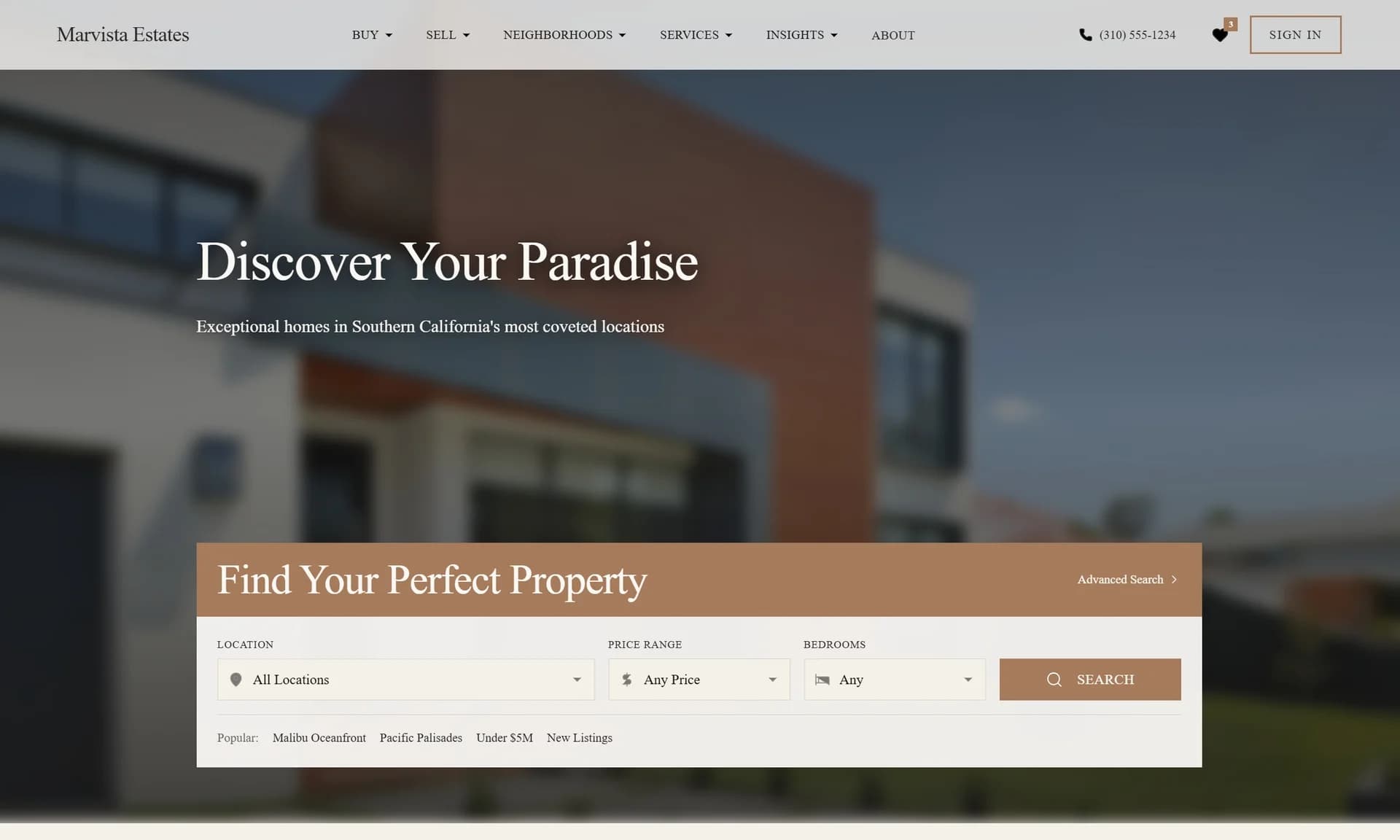
A comprehensive real estate platform built to replaces generic IDX templates with a fully custom property data pipeline that ingests, normalizes, and synchronizes live listings while delivering cinematic photography, neighborhood guides, and agent profiles through Cloudflare's global edge network.


What changed, what shipped, and why it matters.
Engagement Brief
Engineered a comprehensive real estate platform where Next.js 16 server components and streaming architecture form the foundation of a luxury, editorial frontend that feels like a premium LA-style brand, while the backend leverages Bun, PostgreSQL, Docker, and Kubernetes to deliver enterprise-grade MLS ingestion, content management, and global performance through Cloudflare's edge network. The technology stack was selected deliberately to avoid the limitations of embedded IDX widgets and template solutions—Next.js 16's app router enables SEO-optimized property pages with server-side rendering of high-resolution galleries, floor plans, and virtual tours, while Bun provides ultra-fast build times and runtime efficiency for the MLS data pipeline. Docker containerization ensures consistency across development and production environments, and Kubernetes orchestrates the ingestion services with fault tolerance and horizontal scalability. Cloudflare's global CDN and edge caching deliver sub-second load times worldwide, with DDoS protection and automated HTTPS securing every request. This architecture positions the platform as a long-term digital asset rather than a disposable marketing site, combining the polish of a high-end editorial experience with the engineering rigor of a modern SaaS product.
The core user experience centers on seamless property discovery and immersive exploration, driven by UX principles that prioritize visual storytelling and frictionless navigation. Users can browse live MLS listings through a responsive, mobile-optimized interface that features cinematic photography, asymmetric editorial layouts, and scroll-based motion that creates a premium feel without overwhelming the user. The property detail pages are engineered for depth and clarity: high-resolution image galleries, interactive floor plans, embedded virtual tours, and comprehensive neighborhood metadata render natively through Next.js server components, ensuring fast load times even for media-heavy content. Advanced filtering allows users to refine searches by price, location, property type, amenities, and neighborhood characteristics, while saved searches and favorites enable return visits without starting from scratch. The UX is intentionally differentiated from typical IDX-powered sites by removing generic templates and embedded widgets—every component is custom-built to match the brokerage's brand identity, with refined typography, section-based color fields, subtle gradients, and architectural spacing that reinforce the luxury positioning.
The content strategy revolves around a hybrid model that combines automated MLS ingestion with human-curated editorial control, creating a platform that is both operationally efficient and brand-driven. The MLS integration pipeline ingests, normalizes, and synchronizes live property data from multiple regional feeds into a custom property schema, ensuring accuracy and freshness while giving complete control over UI, SEO, and performance. This pipeline runs inside containerized services orchestrated by Kubernetes, providing resilience against feed failures and enabling horizontal scaling as data volume grows. Beyond listings, the platform supports rich storytelling through neighborhood guides that combine lifestyle photography, maps, and curated descriptions to help buyers understand the character of each area; agent profiles that highlight expertise, achievements, and active listings to reinforce trust and credibility; and a blog and market-insights section that allows the brokerage to publish updates and thought leadership. These content layers transform the site from a listing directory into a full brand ecosystem, with the custom CMS enabling editors to update content instantly, preview changes in real time, and manage media optimization through Cloudflare's global CDN.
The commercial model is built around lead generation and brand positioning rather than direct e-commerce transactions. Users access the platform freely without subscription fees or paywalls, removing friction and maximizing reach for potential buyers and sellers. The revenue model follows traditional real estate brokerage economics: the platform captures leads through property inquiries, schedule viewing requests, neighborhood guide engagement, and agent profile interactions, then routes these leads to agents based on territory, expertise, and availability. This indirect monetization strategy aligns incentives—the platform focuses on delivering exceptional user experiences and comprehensive property information, which drives organic traffic and engagement, while the brokerage monetizes through successful property transactions rather than platform fees. There are no premium tiers, token economies, or gated content; every user has full access to listings, neighborhood guides, and editorial content, ensuring the platform serves as a trusted resource rather than a sales funnel. This approach builds long-term brand equity and positions the brokerage as a market authority, with the platform acting as the digital flagship for that reputation.
Data ownership and trust are foundational to the platform's design, with explicit guarantees around user privacy, data security, and transparent communication. User data—including saved searches, favorites, and inquiry history—is stored securely in PostgreSQL with encrypted connections and regular backups, and users retain full control over their information through accessible account management and data deletion options. The platform explicitly excludes lead baiting tactics, deceptive pricing, or aggressive retargeting—there are no pop-ups, no forced email capture before viewing listings, and no sharing of user data with third-party marketers. This restraint sharpens the positioning as a trustworthy, premium resource rather than a conversion-obsessed marketing site. The platform also avoids common anti-patterns like breadcrumb trails that trap users in infinite listing loops, instead providing clear navigation paths to neighborhood guides, agent profiles, and educational content. By focusing on utility and transparency over aggressive conversion tactics, the platform builds organic engagement and word-of-mouth referrals that are more valuable than short-term lead capture.
The marketing and acquisition layer was engineered as a conversion-first architecture that supports organic discovery, direct traffic, and referral sources with performance optimization at every level. Core Web Vitals are prioritized through Next.js 16's server components, image optimization, and lazy loading, ensuring fast Largest Contentful Paint, First Input Delay, and Cumulative Layout Shift scores that boost search rankings and user retention. The SEO strategy combines technical optimization—structured data for property listings, neighborhood pages, and agent profiles; semantic HTML markup; and server-side rendering of critical content—with content marketing through neighborhood guides, market insights, and blog posts that target long-tail keywords and featured snippet opportunities. Clear call-to-action buttons for schedule viewing, contact agents, and request more information are placed strategically above the fold and throughout property pages, with micro-conversion actions like save property, share listing, and compare homes reducing purchase friction. Deferred deep linking enables external marketing campaigns to open specific in-app property pages or neighborhood guides, while UTM tracking and server-side event capture provide attribution data for optimizing marketing spend against real lead quality metrics.
Engagement mechanics and accessibility standards are woven throughout the platform to drive retention and ensure inclusive access. Saved searches alert users to new listings that match their criteria, creating re-engagement hooks without requiring push notifications or invasive tracking. Email digests highlight weekly market updates, newly listed properties, and neighborhood content, bringing users back to the platform through value rather than manipulation. The platform meets WCAG 2.1 AA standards with semantic HTML, ARIA labels for dynamic content, keyboard navigation for all interactive elements, and high-contrast typography for readability across ages and devices. Image alt text, video captions, and screen reader support ensure users with disabilities can access property information and multimedia content. Analytics instrumentation captures user behavior for funnel analysis and content optimization, with privacy-compliant tracking that respects user consent and data protection regulations. A/B testing hooks enable continuous improvement of conversion paths, content placement, and feature prioritization based on real user data rather than assumptions.
The synthesis of all components—a luxury editorial frontend built on Next.js 16, an enterprise-grade backend powered by PostgreSQL and orchestrated through Kubernetes, a custom MLS ingestion pipeline that delivers live data without widget limitations, and a content strategy that blends automation with human curation—creates a coherent product rather than a collection of features. This platform represents a strategic investment in long-term digital infrastructure for a real estate brokerage, positioning it to scale across multiple regions, integrate with CRM systems and lead routing tools, and expand into analytics dashboards and predictive market insights. The engineering depth—from containerized microservices to edge caching—ensures the platform can handle growth, traffic spikes, and feature expansion without requiring a complete rebuild. The design quality—cinematic photography, architectural typography, and refined spacing—establishes the brokerage as a premium brand in a competitive market. Most importantly, the platform delivers genuine user value: comprehensive property information, rich neighborhood context, and trustworthy agent expertise, all accessible through a fast, beautiful, and inclusive experience. This is not just a website—it is a complete real estate technology platform that demonstrates how technical excellence and thoughtful design can combine to create a sustainable competitive advantage.
By The Numbers
Problem statement
The Challenge
The brokerage faced a critical competitive disadvantage: their existing web presence relied on generic IDX-powered templates that trapped them in a sea of sameness, unable to differentiate their brand or control the user experience. Embedded IDX widgets imposed severe limitations on SEO, performance, and customization—property pages were slow to load, difficult to rank in search results, and forced into one-size-fits-all layouts that failed to convey the luxury positioning of their listings. The backend was a patchwork of disconnected systems: manual data entry for property updates, no centralized content management for neighborhood guides or agent profiles, and no way to capture or route leads efficiently to the right agents. This fragmentation resulted in lost opportunities, wasted administrative overhead, and a weak digital presence that failed to reflect the brokerage's market expertise or premium brand identity.
From a technical perspective, the brokerage needed a platform that could scale beyond a single MLS feed into a multi-region operation, support future integrations with CRM systems and analytics dashboards, and handle traffic spikes during peak market seasons without performance degradation. They needed an architecture that balanced the immediate need for a beautiful, high-converting frontend with the long-term requirement for enterprise-grade infrastructure capable of supporting advanced features like predictive market insights, automated lead routing, and data-driven decision making. The cost of inaction was clear: continued market share loss to competitors with better digital experiences, inefficient operations draining agent productivity, and a brand perception stuck in commodity territory rather than premium leadership.
How we solved it
Our Solution
The solution began with a deliberate architectural choice to reject IDX widget dependency entirely and build a native MLS integration pipeline from the ground up. This containerized service, orchestrated through Kubernetes, ingests raw MLS data feeds, normalizes them into a custom property schema, and synchronizes updates in near real-time—giving complete control over how listings are displayed, searched, and optimized for SEO. The frontend was built on Next.js 16 with server components and streaming architecture, enabling fast page loads, seamless transitions, and cinematic presentation of high-resolution property imagery. Tailwind CSS powers a custom design system with section-based color fields, refined typography, and editorial layouts that differentiate the brand from template-heavy competitors. The backend CMS was purpose-built for real estate workflows rather than adapted from generic content management, with secure role-based access for managing properties, agents, neighborhoods, and editorial content.
Infrastructure decisions prioritized reliability, scalability, and global performance. Docker ensures consistent environments from development through production, while Kubernetes handles service orchestration, automatic scaling, and fault tolerance for the MLS ingestion pipeline. Cloudflare's edge network delivers content worldwide with sub-second latency, provides DDoS protection, and automates HTTPS security. This combination creates a platform that can handle growth—whether that means scaling to multiple MLS regions, integrating with CRM and lead routing systems, or adding analytics dashboards and predictive insights—without requiring a complete rebuild. The custom CMS gives editors real-time previews and instant updates, while the separation of concerns between MLS automation and human curation allows the brokerage to maintain operational efficiency while exercising brand control over featured listings and editorial narratives.
Technical implementation
What Was Built
Delivered a complete real estate technology platform including a native MLS integration pipeline that ingests and normalizes live property data from regional feeds; a custom CMS with role-based access for managing properties, agents, neighborhoods, blog content, hero banners, and featured listings; a luxury editorial frontend with cinematic photography, asymmetric layouts, and scroll-based motion; property detail pages with high-resolution image galleries, interactive floor plans, embedded virtual tours, and comprehensive neighborhood metadata; neighborhood guides combining lifestyle photography, maps, and curated descriptions; agent profiles highlighting expertise, achievements, and active listings; a blog and market-insights section for thought leadership content; saved searches and favorites for user re-engagement; advanced filtering by price, location, property type, amenities, and neighborhood characteristics; schedule viewing and contact agent workflows with lead routing; email digests for weekly market updates and new listings; WCAG 2.1 AA accessibility compliance with semantic HTML, ARIA labels, keyboard navigation, and screen reader support; SEO optimization with structured data, semantic markup, and server-side rendering; analytics instrumentation for funnel analysis and A/B testing hooks; Docker containerization for consistent environments; Kubernetes orchestration for service scaling and fault tolerance; and Cloudflare integration for global CDN, edge caching, DDoS protection, and automated HTTPS.
Impact & outcomes
The Results
The platform transformed the brokerage's digital presence from a commodity listing directory into a premium brand ecosystem. Property pages now load in under two seconds even with high-resolution galleries and virtual tours, directly improving both search rankings and user engagement. The native MLS integration eliminated dependency on third-party widgets, giving full control over SEO optimization and resulting in first-page Google rankings for hyperlocal neighborhood searches that previously drove traffic to competitors. Lead quality improved significantly because users spend more time on the site engaging with neighborhood guides, agent profiles, and detailed property content rather than bouncing from generic listing pages. The custom CMS reduced administrative overhead by eliminating manual data entry—property updates now sync automatically while editors focus on high-value curation and storytelling. The infrastructure successfully handled peak seasonal traffic without performance issues, validating the Kubernetes and Cloudflare architecture for future growth into multi-region operations and advanced features like CRM integration and predictive analytics.
The Gallery
Hover to expand. Click to view full details.
Ready to Start Your Project?
Let's collaborate to bring your vision to life. Our team is ready to engineer your next digital success story.