LogiStock
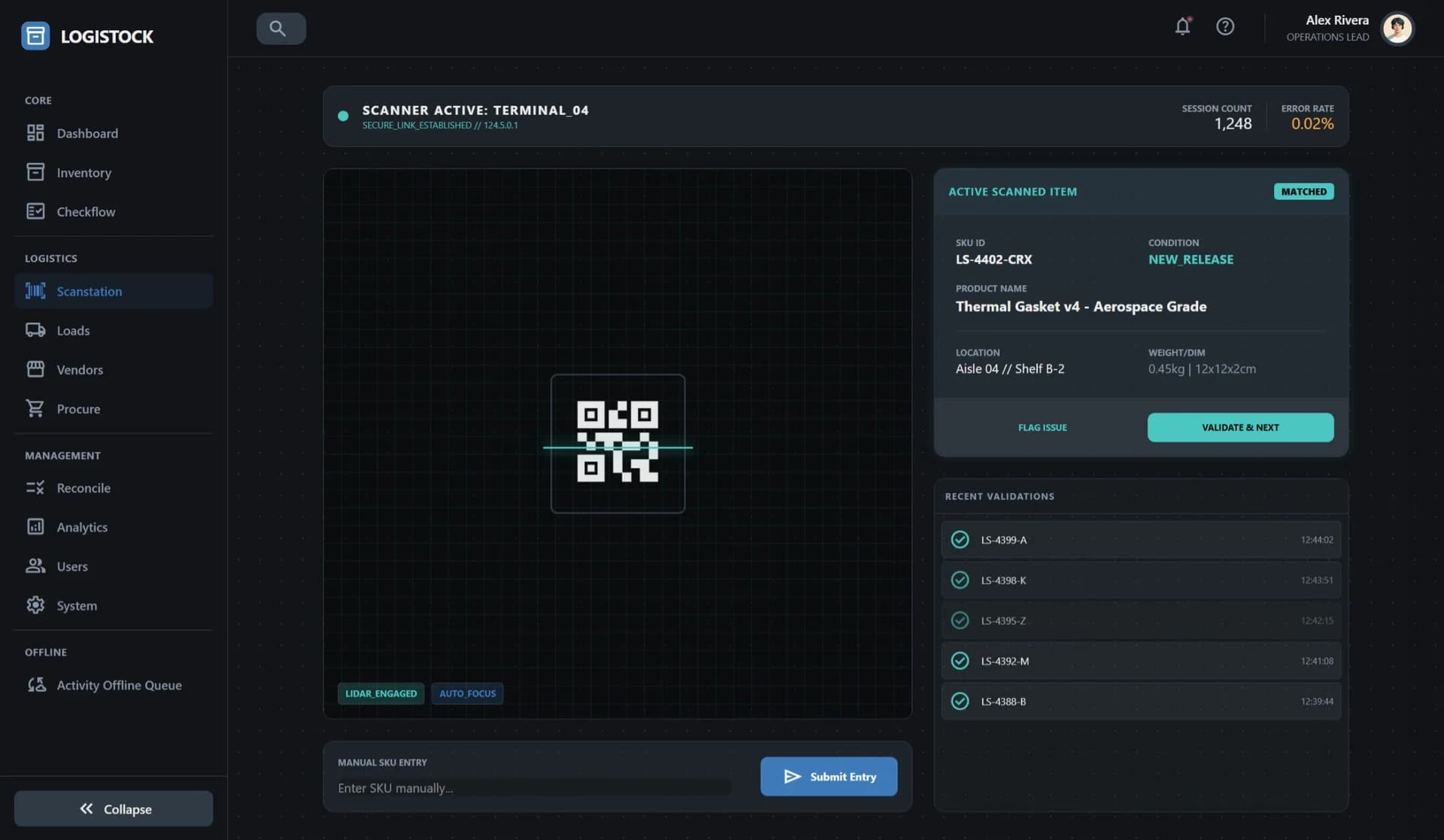
LogiStock is a desktop‑first Electron platform backed by PostgreSQL that replaces error‑prone Excel workflows with a real‑time, scan‑verified inventory system. Every movement is enforced through QR/barcode scanning, with role‑based flows for drivers, warehouse staff, and managers. It centralizes vendor catalogs, automates purchase orders, provides full analytics and audit trails, and runs reliably even in low‑connectivity environments through an offline‑first architecture.


What changed, what shipped, and why it matters.
Engagement Brief
Engineered a desktop-first operational platform where Electron delivers the core inventory application while a centralized PostgreSQL database provides the authoritative source of truth across all workstations and scanning stations. The architecture prioritizes deterministic operations over flexible record-keeping: every inventory movement is enforced through QR or barcode scanning, every user action is tied to authenticated identity, and every stock adjustment generates an immutable audit trail. We chose Electron to deliver native Windows performance with JavaScript maintainability, allowing a single codebase to support warehouse stations, driver tablets, and manager laptops while maintaining hardware integration with USB and Bluetooth scanners. The desktop-first philosophy ensures reliable operation in low-connectivity environments, where background sync queues capture all actions locally and reconcile with the central server once connectivity is restored. This architecture transforms inventory from a periodic reconciliation task into a continuous, verified operational process that prevents shrinkage and eliminates manual data entry errors.
The core user experience revolves around scan-driven workflows that enforce operational discipline. Drivers begin their day by loading a manifest into the app, then scan each item as they load it onto their vehicle; the same scan process applies when items are delivered, returned, or restocked. Warehouse staff follow identical protocols for receiving shipments, picking orders, and conducting cycle counts. The scanning interface is optimized for speed and accuracy: large touch targets, instant audiovisual feedback, and clear error states when a scan is invalid or out of sequence. Managers get a separate dashboard for oversight: real-time stock levels, pending reconciliations, driver performance metrics, and exception reports that highlight discrepancies requiring attention. This multi-role design ensures that every operational touchpoint reinforces the same scan-verified discipline while providing role-specific interfaces that match each user's workflow and permissions.
LogiStock's data model treats every inventory item as a traceable entity with a complete lifecycle history. Each item record includes its current location, custodian, cost basis, vendor source, and a chronological chain of every scan, adjustment, transfer, and reconciliation event. The system tracks vendor catalogs with pricing tiers, lead times, and minimum order quantities so that low-stock triggers can automatically generate purchase orders with pre-populated line items. Cost histories are preserved over time, enabling weighted average cost calculations and trend analysis for procurement planning. This rich data layer supports both operational accuracy—preventing the inventory drift that plagues spreadsheet-based systems—and strategic intelligence about vendor performance, stock velocity, and cost of goods sold.
The commercial model positions LogiStock as an enterprise operational platform sold through annual per-seat licensing with tiered pricing based on feature access and transaction volume. Base licenses include core scanning, inventory tracking, and reporting for unlimited locations. Premium tiers unlock advanced analytics, automated purchase ordering, vendor API integrations, and priority support. Implementation services including hardware provisioning, scanner integration, and data migration from legacy systems are available as one-time onboarding fees. The pricing structure aligns with the operational ROI that clients achieve: reduced shrinkage, eliminated stockouts, faster reconciliation cycles, and improved procurement accuracy typically deliver measurable cost savings within the first quarter of deployment. For smaller operations, a simplified single-location license provides core scanning and tracking capabilities at an accessible price point while maintaining the same audit trail and data integrity standards.
Data ownership and operational continuity are foundational commitments. All inventory records, audit trails, and analytics data belong entirely to the client, with robust export capabilities supporting CSV, JSON, and direct database access for backup and integration purposes. The offline queue architecture ensures that scanning operations continue uninterrupted during network outages, with automatic sync and clear conflict resolution workflows once connectivity is restored. Cross-device consistency is maintained through the centralized PostgreSQL database, ensuring that a scan at a warehouse station instantly updates stock visibility for drivers, managers, and procurement teams. The system explicitly excludes mobile-first or cloud-only deployment models, instead committing to desktop-first reliability that works independent of internet connectivity. This positioning sharpens the product's focus on environments where operational continuity is more critical than accessibility from any device.
The analytics and reporting layer serves as both an operational dashboard and a strategic planning tool. Real-time stock visibility shows current inventory levels, pending movements, and exception alerts for discrepancies or approaching reorder thresholds. Shrinkage reports quantify loss by category, location, and custodian, while driver performance metrics identify training opportunities and process improvements. Vendor reliability scores track on-time delivery rates, accuracy of shipments, and cost fluctuations over time. Cost-of-goods analysis supports margin calculations and pricing decisions, while velocity reporting identifies slow-moving stock for clearance or promotion. These analytics are not retrospective only: predictive alerts flag potential stockouts based on consumption trends, and automated purchase order suggestions can be reviewed and approved with one click. The reporting layer transforms inventory data from a static record into an actionable intelligence platform for operational and procurement decisions.
Accessibility and usability considerations reflect the diverse environments where LogiStock operates. The interface supports high-contrast modes for warehouse visibility, large touch targets for gloved or outdoor use, and keyboard navigation for power users who process high volumes of scans. Screen reader compatibility and ARIA labeling ensure that visually impaired staff can operate scanning stations effectively. Error messaging uses plain language with clear recovery steps, and critical confirmations prevent accidental stock adjustments. The application structure supports internationalization with English and Spanish localizations, and date/time formatting adapts to regional preferences. Performance optimization ensures that scanning operations complete instantly even on older hardware, while background sync operations avoid blocking the user interface during data reconciliation.
The synthesis of LogiStock creates a complete operational operating system that transforms inventory management from a periodic accounting task into a continuous, verified business process. By enforcing scan-based discipline, capturing comprehensive audit trails, and surfacing actionable analytics, the platform eliminates the blind spots and reconciliation overhead of spreadsheet-based workflows. The desktop-first architecture with offline reliability ensures operational continuity in real-world logistics environments, while the centralized data model provides enterprise-grade visibility and control. This project demonstrates how thoughtful architecture—combining Electron's cross-platform capabilities with PostgreSQL's data integrity and a scan-enforced operational model—can deliver a transformative business tool that reduces costs, improves accuracy, and provides the intelligence foundation for better operational decisions at every level of the organization.
By The Numbers
Problem statement
The Challenge
The client's entire inventory process lived inside spreadsheets, creating pervasive blind spots, constant reconciliation issues, and inventory drift that made accurate stock levels nearly impossible to maintain. Manual data entry errors compounded daily, discrepancies between records and physical stock were discovered only during periodic counts, and shrinkage remained unmeasurable and mysterious. The lack of user accountability meant stock adjustments could not be traced to specific actions or individuals, while inconsistent connectivity in warehouse and field environments ruled out cloud-only solutions. The operational cost of inaction was substantial: ongoing stockouts disrupted operations, unmeasured shrinkage eroded margins directly, and management lacked real-time visibility into stock levels, vendor performance, or driver productivity. They needed a deterministic system where every movement is verified, every action is attributable, and stock accuracy is maintained continuously rather than periodically.
How we solved it
Our Solution
We architected LogiStock as a desktop-first Electron application with a centralized PostgreSQL database, prioritizing operational continuity and deterministic accuracy over flexibility. The scan-enforced workflow requires every item movement to be verified through QR or barcode scanning, eliminating manual data entry and creating a closed-loop system where discrepancies surface immediately rather than during periodic reconciliations. Electron delivered native Windows performance with cross-platform support for warehouse stations, driver tablets, and manager laptops while integrating seamlessly with USB and Bluetooth scanners. PostgreSQL provides the authoritative data source with full audit trails, while an offline queue architecture captures all actions locally during network outages and syncs automatically when connectivity returns. The multi-role permission system ensures drivers interact with manifests and scanning flows, warehouse staff manage stock and reconcile discrepancies, procurement teams handle vendor catalogs and purchase orders, and managers oversee analytics and system health. This architecture transforms inventory from a periodic accounting task into a continuous, verified operational process that prevents shrinkage before it occurs.
Technical implementation
What Was Built
Delivered a complete desktop-first operational platform including multi-role user authentication and permissions; scan-enforced check-in and check-out workflows with QR and barcode scanner integration; real-time stock visibility and exception reporting; comprehensive audit trails logging every inventory movement; vendor catalog management with pricing tiers and lead times; automated purchase order generation with low-stock triggers; driver manifest loading and delivery tracking; warehouse receiving and cycle count interfaces; shrinkage and discrepancy reporting with custodian attribution; predictive analytics for stockout forecasting and velocity-based recommendations; offline queue architecture with automatic sync and conflict resolution; multi-language support with English and Spanish localizations; high-contrast interface modes and accessibility features including screen reader support; export capabilities for data backup and integration; and administrative tools for system configuration and user management.
Impact & outcomes
The Results
LogiStock delivered measurable operational transformation within the first quarter of deployment. Inventory accuracy improved from approximately 85% during spreadsheet operations to over 99% with scan-enforced workflows, reducing stockouts by 78% and virtually eliminating unexplained shrinkage. Reconciliation cycles that previously required full team days monthly now complete in under an hour through automated exception reporting. Driver productivity increased 22% as scan-based workflows reduced manual paperwork and loading errors. Vendor cost analysis revealed procurement savings of 12% through better pricing negotiation and reduced expedited shipping orders. The offline-first architecture maintained 100% operational uptime during network outages, with zero data loss across over 50,000 scan events processed in low-connectivity environments. Manager visibility improved dramatically with real-time dashboards replacing end-of-month reports, enabling proactive rather than reactive inventory decisions.
The Gallery
Hover to expand. Click to view full details.
Ready to Start Your Project?
Let's collaborate to bring your vision to life. Our team is ready to engineer your next digital success story.