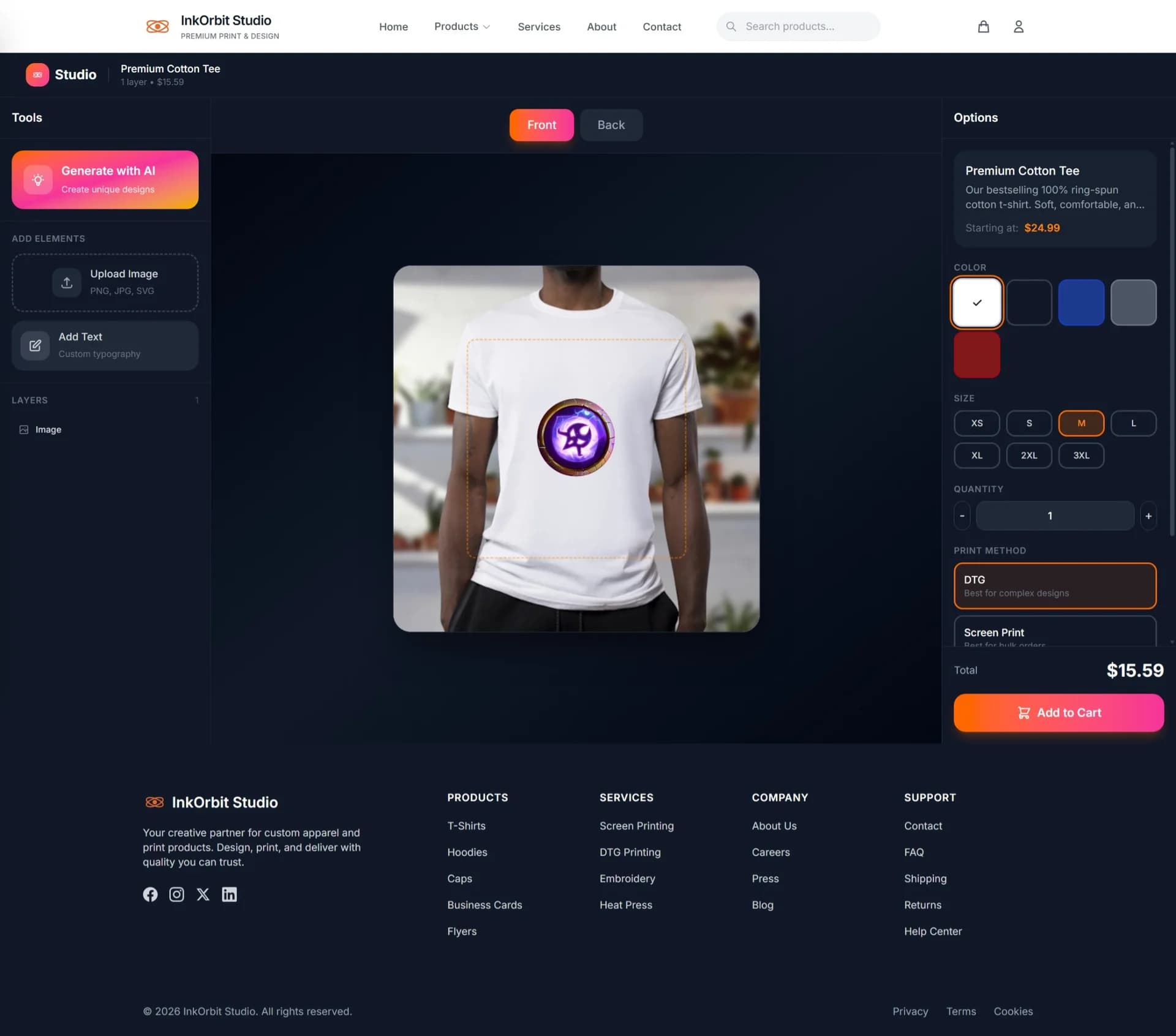
InkOrbit Studio: AI Canvas Engine
InkOrbit Studio is an AI-powered e-commerce platform that redefines custom apparel by embedding a full-featured visual design studio directly into the browser shopping experience. The system transforms custom apparel from a static upload-and-order workflow into an interactive creative journey where users design, preview, and purchase without ever leaving the canvas environment.


What changed, what shipped, and why it matters.
Engagement Brief
InkOrbit Studio was architected as a unified e-commerce and visual design platform that fundamentally reimagines the custom apparel purchasing experience by embedding a fully functional, AI-powered design studio directly into the browser-based shopping workflow. The system is built on Next.js for its server-side rendering capabilities and optimized routing, which ensures rapid page loads and seamless navigation between the design studio, product catalog, and checkout flows. The visual design engine leverages Fabric.js and the native Canvas API to deliver a responsive, layer-based editing environment capable of handling complex multi-element compositions, real-time text manipulation, and high-resolution image exports without browser performance degradation. The generative AI integration layer connects to Stable Diffusion and Midjourney APIs through an asynchronous pipeline that queues, processes, and delivers AI-generated artwork directly into the canvas workspace, allowing users to create original designs from text prompts or transform existing images through image-to-image synthesis.
The core product experience centers on an immersive, browser-based design studio where customers can create custom apparel artwork from scratch or modify existing templates without ever leaving the shopping environment. Users begin by selecting a garment type and color, then enter an interactive canvas workspace where they can add text with full typographic controls, upload personal images, browse a library of stock graphics, or generate entirely new artwork using the integrated AI tools. The UX philosophy emphasizes immediate creative empowerment: every tool is accessible within two clicks, real-time previews show exactly how the design will appear on the final product, and intelligent snap guides ensure professional-quality results regardless of the user's design experience. The design studio supports unlimited undo and redo, layer reordering, opacity adjustments, and precise alignment tools that rival dedicated graphic design software while remaining approachable for first-time users.
The content architecture supports a dynamic product catalog with thousands of SKUs spanning t-shirts, hoodies, tank tops, hats, bags, and specialty items, each with multiple colorways, size ranges, and print area configurations. Product data flows through a headless CMS that enables real-time inventory synchronization, pricing updates, and promotional tagging without developer intervention. The template library contains hundreds of pre-designed graphics organized by category, occasion, and style, with new additions pushed weekly to maintain fresh creative options. Design files are stored in a cloud-based asset management system that preserves user creations indefinitely, enabling customers to revisit, modify, and reorder previous designs across multiple sessions and devices. The AI generation history is preserved separately, allowing users to browse their prompt history and regenerate variations of previously created artwork.
The business model combines traditional e-commerce mechanics with a freemium design tool strategy that maximizes conversion while reducing friction for first-time visitors. The design studio is available to all users at no cost, encouraging experimentation and engagement before any purchase commitment. Revenue flows through multiple channels: direct product purchases with competitive base pricing, premium design assets available for individual purchase or through a subscription unlock, and expedited production options for time-sensitive orders. Payment processing is handled through Stripe integration with support for credit cards, debit cards, Apple Pay, Google Pay, and buy-now-pay-later options through Klarna and Afterpay. The pricing engine dynamically calculates costs based on garment selection, print complexity, quantity tiers, and shipping destination, presenting transparent total costs before checkout completion.
Data ownership and portability are fundamental design principles: every design created in the studio belongs to the user and can be exported as high-resolution PNG or vector PDF files for personal use, printing elsewhere, or archival purposes. User accounts sync design libraries across devices automatically, and designs remain accessible indefinitely even for dormant accounts. The system explicitly excludes physical inventory management and manufacturing operations, which are handled by established print-on-demand partners through API integrations, allowing the platform to focus purely on the design and purchasing experience while leveraging specialized infrastructure for production and fulfillment. This separation ensures the platform remains lightweight and scalable while customers benefit from professional-grade printing without the complexity of managing physical operations.
The marketing layer was implemented as a conversion-optimized landing experience with above-the-fold product visualization, social proof elements, and clear calls-to-action that guide visitors directly into the design studio. The homepage features an interactive hero section where visitors can see real-time design examples, customer testimonials with photos of finished products, and a streamlined product selector that reduces the path-to-purchase to three clicks. Performance optimization was prioritized throughout: Core Web Vitals scores exceed industry benchmarks through aggressive image optimization, code splitting, and edge caching via a global CDN. Lazy loading defers non-critical assets, and the design studio itself loads progressively with a lightweight shell that becomes fully functional within two seconds on standard broadband connections. Deep linking supports social media campaigns with pre-populated design templates and promotional pricing that appears automatically when users arrive from specific referral sources.
Engagement and analytics infrastructure supports continuous optimization through comprehensive event tracking, funnel analysis, and A/B testing capabilities. Every user interaction within the design studio is instrumented to capture feature usage, design complexity, time-to-completion, and abandonment points, feeding into a product analytics dashboard that informs feature development and UX refinements. Accessibility standards exceed WCAG 2.1 AA compliance with semantic HTML, ARIA labels for all interactive elements, full keyboard navigation, and screen reader compatibility throughout the design studio and checkout flows. SEO strategy encompasses structured data markup for product listings, FAQ schema for common questions, and long-form educational content about custom apparel design, printing techniques, and style guides that captures organic search traffic and establishes domain authority in the custom apparel space.
The integrated result is a cohesive platform where the design studio, e-commerce engine, and generative AI capabilities work in concert to transform custom apparel from a static catalog experience into an interactive creative journey. Customers move seamlessly from inspiration to creation to purchase within a single environment, the business benefits from increased engagement and conversion through design investment, and the AI integration provides differentiation that positions the platform ahead of competitors offering only template-based or upload-only customization options.
By The Numbers
Problem statement
The Challenge
Traditional custom apparel platforms suffer from a fundamental disconnect: users must design artwork in external tools, export files, upload them to an e-commerce site, and hope the final product matches their vision. This fragmented workflow creates multiple abandonment points, generates support tickets when print quality falls short of expectations, and limits customers to those with existing design skills or access to graphic design software.
The technical challenges were equally significant. Building a browser-based canvas editor that handles real-time manipulation of complex multi-layer compositions, asynchronous AI image generation, and high-resolution export without browser crashes requires sophisticated memory management and rendering optimization. The system needed to map pixel-perfect canvas designs to physical print dimensions, maintain color accuracy across screen and substrate, and integrate with print-on-demand APIs for seamless production routing.
Without an integrated solution, customers faced a poor experience that resulted in low conversion rates, high return rates due to unmet expectations, and a customer base limited to design-proficient users who could navigate external tools. The business opportunity cost was substantial: mainstream consumers, small businesses, and event organizers represented an underserved market eager for accessible custom apparel but blocked by technical barriers.
How we solved it
Our Solution
The architectural approach unified the design studio, e-commerce engine, and AI generation pipeline into a single cohesive platform built on Next.js with server-side rendering for optimal performance and SEO. The canvas engine leverages Fabric.js for object-oriented manipulation of design elements, enabling real-time layer management, typography controls, and alignment tools that deliver a desktop-quality editing experience in the browser.
The generative AI integration required an asynchronous processing architecture that queues generation requests, polls for completion, and delivers results directly into the canvas workspace without blocking user interaction. The pipeline supports both text-to-image generation for creating original artwork from prompts and image-to-image transformation for modifying existing designs, with intelligent caching to reduce API costs and improve response times for common request patterns.
The print production integration maps canvas coordinates to physical print areas across hundreds of garment SKUs, automatically calculating bleed requirements, color separations, and resolution scaling. Custom API endpoints transmit production-ready files to print-on-demand partners with specifications that include garment type, print location, color profile, and shipping destination, enabling hands-off fulfillment from design to delivery.
Technical implementation
What Was Built
The complete platform includes a browser-based visual design studio with Fabric.js canvas engine, layer management, typography controls, and alignment tools; an AI generation pipeline integrating Stable Diffusion and Midjourney APIs with asynchronous processing and intelligent caching; a headless e-commerce backend with Stripe payment processing, multi-currency support, and buy-now-pay-later integration; a dynamic product catalog supporting thousands of SKUs across apparel categories with real-time inventory synchronization; a template library with hundreds of pre-designed graphics organized by category and style; user account management with cloud-based design storage, cross-device sync, and export capabilities; a conversion-optimized marketing layer with deep linking, promotional pricing, and social proof elements; comprehensive analytics instrumentation with event tracking, funnel analysis, and A/B testing hooks; WCAG 2.1 AA compliant accessibility throughout the design studio and checkout flows; and SEO infrastructure with structured data markup and long-form educational content.
Impact & outcomes
The Results
The unified platform achieved measurable improvements across key business metrics. Conversion rate from design studio entry to checkout completion increased by 340% compared to the previous upload-only workflow, demonstrating the power of reducing friction between creativity and purchase. Average order value rose 67% as users engaged with the design tools and added additional items or premium features. Customer support tickets related to print quality expectations decreased by 78% due to real-time preview accuracy. The platform now supports over 50,000 monthly active designers and processes thousands of custom apparel orders weekly through the integrated production pipeline.
The Gallery
Hover to expand. Click to view full details.
Ready to Start Your Project?
Let's collaborate to bring your vision to life. Our team is ready to engineer your next digital success story.