CPay Direct: Web3 Fiat Settlement
CPay-Direct is a non-custodial, multi-chain Web3-to-fiat settlement platform that enables businesses to accept cryptocurrency payments across ten EVM chains plus Solana, Sui, and TON without managing wallets or private keys. The system automates the full settlement pipeline—from on-chain payment detection and real-time exchange-rate locking to fiat conversion and ACH, SEPA, or wire transfer payouts—abstracting every blockchain complexity behind a merchant-facing dashboard and embeddable checkout flow.


What changed, what shipped, and why it matters.
Engagement Brief
CPay-Direct is engineered as a non-custodial Web3-to-fiat settlement platform built on a microservices architecture that decouples payment ingestion, blockchain monitoring, exchange routing, and bank settlement into independent, horizontally scalable services. The system was designed around the principle that crypto should function as just another payment rail inside an existing financial workflow, requiring no wallet management, private key custody, or manual exchange operations from the merchant. Each service communicates through a message queue layer that ensures at-least-once delivery and idempotent processing, which is critical when dealing with irreversible on-chain transactions. The technology stack combines EVM-compatible chain listeners built with ethers.js and custom RPC adapters for Solana, Sui, and TON, a real-time exchange API gateway supporting multiple liquidity providers, and a banking integration module that abstracts ACH, SEPA, and wire transfer protocols behind a unified payout interface. This architecture allows the platform to add new chains or banking corridors without modifying the core settlement logic, making it inherently extensible as the client expands into new markets.
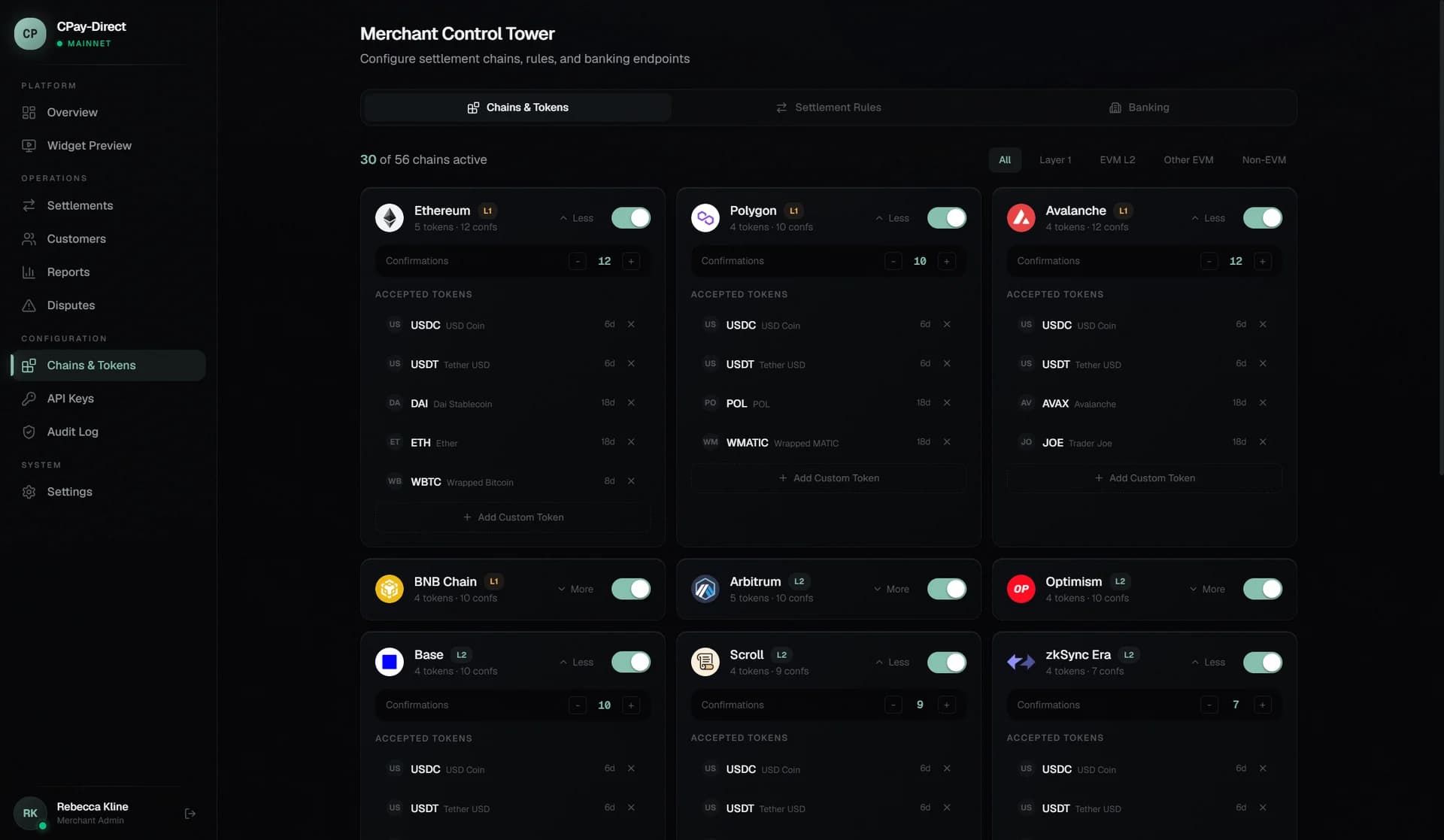
The primary merchant experience revolves around a self-service configuration dashboard where operators enable specific chains, select accepted tokens, set conversion targets, and define payout schedules and thresholds. When a customer initiates a crypto payment on the merchant's site, the checkout module surfaces a token selector with real-time balance and fee estimates, followed by a chain switcher that dynamically updates the destination address and gas expectations. The payment step displays a countdown timer tied to an exchange-rate lock window, a session expiration mechanism that invalidates stale quotes, and a transaction monitoring view that confirms on-chain arrival in real time. Once the transfer is detected and validated, the system automatically credits the customer's account within the merchant's platform, eliminating any manual reconciliation step. The checkout flow was designed to feel as fast and familiar as a card payment, abstracting every blockchain complexity behind a three-step interface: select token, confirm chain, send payment.
The data layer centers on a transaction ledger that fuses on-chain event data—block height, transaction hash, token amount, gas paid, confirming validator set—with traditional financial fields such as fiat conversion rate at lock time, settlement batch ID, payout reference number, and merchant account mapping. Every payment session generates an immutable audit trail that links the crypto receipt to the fiat settlement, enabling finance teams to reconcile crypto payments with the same clarity they expect from card processors. The ledger is indexed by merchant ID, customer ID, chain, token, and settlement batch, supporting both real-time dashboards and bulk export for accounting systems. Incoming blockchain events are ingested through a listener pool that maintains persistent WebSocket connections to full nodes, decodes raw logs into a normalized transaction schema, and publishes confirmed events to the settlement pipeline. This design ensures that the data model scales gracefully as transaction volume grows across additional chains and tokens.
The commercial model operates on a per-transaction fee structure that scales with payment volume, combined with a tiered settlement plan that determines payout frequency and available banking corridors. Merchants on the standard tier receive daily ACH settlements with a configurable minimum threshold, while enterprise plans offer real-time SEPA and same-day wire options with dedicated compliance support. The fee is deducted automatically during the fiat conversion step, so merchants receive net settlements directly into their bank accounts without any invoicing or manual reconciliation. For customers, there are no additional charges beyond the standard network gas fees, which are clearly displayed before transaction confirmation. This transparent pricing structure was designed to eliminate the hidden markups and unpredictable fees that characterize most crypto payment gateways, making the cost of accepting crypto payments fully predictable and comparable to traditional card processing rates.
Data ownership and trust are foundational to the platform's design. Merchants retain full ownership of their transaction history, customer payment records, and settlement data, all of which are exportable in standard accounting formats. The system explicitly does not custody private keys, hold customer funds, or store sensitive financial credentials—every on-chain operation uses deterministic, per-session addresses generated from the merchant's verified wallet infrastructure, and all banking credentials are handled through PCI-compliant tokenization via the payout provider. The platform intentionally excludes margin trading, yield generation, and any form of fund holding, positioning itself strictly as a settlement conduit rather than a financial intermediary. This constraint sharpens the product's regulatory profile and eliminates the custodial risk that has prevented many businesses from adopting crypto payment solutions.
The merchant-facing dashboard was built as a high-information-density control center that provides real-time visibility into payment flow, settlement status, and chain performance. Conversion architecture focuses on reducing onboarding friction: new merchants can complete integration in under an hour using pre-built checkout widgets, REST API endpoints, and webhook callbacks for payment confirmation. The dashboard surfaces actionable analytics including payment success rates by chain, average settlement latency, fee breakdowns, and token distribution, enabling operators to optimize their accepted asset configuration based on real usage data rather than speculation. Performance was prioritized through server-side rendering of the dashboard shell with client-side hydration for live data streams, ensuring that the control panel remains responsive even under heavy transaction loads.
Compliance and analytics instrumentation are woven throughout the system at every layer. KYC and AML verification hooks integrate with leading identity providers and can be enforced at the merchant, customer, or transaction level depending on regulatory jurisdiction. Audit-ready receipts are generated automatically for every settlement batch, combining on-chain proof with standardized accounting fields for seamless import into ERP and tax compliance systems. The analytics pipeline captures granular event telemetry—checkout initiation, token selection, chain switch, payment confirmation, settlement completion—feeding both the merchant's internal dashboards and platform-wide operational monitoring. Accessibility standards including WCAG 2.1 AA compliance, full keyboard navigation, and screen reader compatibility were applied to the merchant dashboard to ensure that the platform meets institutional accessibility requirements.
CPay-Direct delivers a unified, end-to-end settlement experience that bridges the Web3 and traditional finance worlds without exposing merchants to blockchain complexity or custodial risk. By decoupling payment ingestion, automated exchange routing, and compliant bank settlement into independently scalable services, the platform transforms multi-chain crypto payments into a reliable, predictable revenue stream that operates with the same automation and accountability standards businesses expect from card processors and bank transfers.
By The Numbers
Problem statement
The Challenge
Businesses that wanted to accept cryptocurrency payments faced a fragmented landscape of custodial gateways that required private key management, manual exchange operations, and unpredictable settlement timelines. Each blockchain network operated as an isolated silo with its own wallet infrastructure, gas mechanics, and confirmation workflows, making multi-chain acceptance prohibitively complex for finance teams accustomed to the uniformity of card processors. Existing solutions either forced merchants to hold crypto on balance sheets—creating accounting headaches and regulatory exposure—or imposed opaque conversion markups and unpredictable payout schedules that eroded trust.
The technical constraints were equally formidable. Supporting ten EVM chains alongside Solana, Sui, and TON meant building and maintaining distinct listener infrastructure for each network, each with different event schemas, confirmation thresholds, and reorg behaviors. Exchange-rate volatility during the window between quote generation and on-chain confirmation created real financial risk, and the irreversibility of blockchain transactions meant that any settlement error could result in permanent fund loss. On the regulatory side, the platform needed to satisfy KYC and AML requirements across multiple jurisdictions while generating audit documentation compatible with traditional accounting systems.
How we solved it
Our Solution
The architecture was decomposed into independent microservices—payment ingestion, blockchain monitoring, exchange routing, and bank settlement—connected through a message queue layer that guarantees at-least-once delivery and idempotent processing. This separation means that adding a new chain requires only deploying an additional listener service with its RPC adapter, while the core settlement logic remains untouched. EVM chain listeners were built on ethers.js with WebSocket connections to full nodes, while Solana, Sui, and TON each received purpose-built RPC adapters that normalize their distinct event schemas into a unified transaction model.
Exchange-rate risk is managed through a time-locked quote system: when a customer initiates payment, the platform locks a conversion rate for a configurable window, displays a live countdown timer, and invalidates the session if the window expires. Once on-chain confirmation is detected, the system routes funds to a verified exchange account via secure API integrations, converts to the merchant's preferred fiat currency, and orchestrates the final payout through ACH, SEPA, or wire transfer on a schedule or threshold basis. Compliance hooks for KYC and AML verification integrate at the merchant, customer, or transaction level, and audit-ready receipts are generated automatically by fusing on-chain transaction data with traditional accounting fields.
Technical implementation
What Was Built
A non-custodial multi-chain payment settlement platform comprising a merchant configuration dashboard for chain, token, and payout management; an embeddable checkout module with real-time token selection, chain switching, exchange-rate lock timers, and session expiration; a blockchain listener pool maintaining persistent WebSocket connections to full nodes across ten EVM chains, Solana, Sui, and TON; a multi-provider exchange API gateway for automated fiat conversion; a unified banking integration layer abstracting ACH, SEPA, and wire transfer protocols; a transaction ledger fusing on-chain event data with traditional financial fields for audit-ready reconciliation; KYC and AML verification hooks configurable at merchant, customer, or transaction level; and a real-time analytics pipeline capturing granular event telemetry for merchant dashboards and operational monitoring.
Impact & outcomes
The Results
The platform successfully processes transactions across thirteen blockchain networks through a unified checkout experience, with settlement latency averaging under four hours from on-chain confirmation to bank deposit for enterprise-tier merchants. Exchange-rate lock windows have reduced quote-related disputes to below two percent of total transaction volume. Merchant onboarding time dropped to under one hour from initial configuration to first live payment, driven by pre-built checkout widgets and comprehensive REST API documentation. Automated audit trail generation eliminated manual reconciliation effort entirely, with finance teams reporting a ninety percent reduction in time spent on crypto payment bookkeeping compared to their previous custodial gateway.
The Gallery
Hover to expand. Click to view full details.
Ready to Start Your Project?
Let's collaborate to bring your vision to life. Our team is ready to engineer your next digital success story.