CogniSearch Enterprise Vault
CogniSearch Enterprise Vault is a fully localized, offline-first native desktop application that delivers AI-powered document search and retrieval while maintaining absolute data sovereignty for enterprise clients.


What changed, what shipped, and why it matters.
Engagement Brief
CogniSearch Enterprise Vault is a fully localized, offline-first native desktop application engineered to deliver AI-powered document search and retrieval capabilities while maintaining absolute data sovereignty for enterprise clients. The system architecture centers on a native desktop build leveraging C# and .NET for Windows environments with Tauri as a cross-platform alternative for broader deployment, ensuring deep integration with local filesystem permissions and hardware acceleration for model inference. The technology stack was deliberately selected to eliminate external dependencies: llama.cpp provides quantized Large Language Model inference running entirely on consumer-grade hardware, ChromaDB serves as the local vector database for semantic embeddings, and the Retrieval-Augmented Generation pipeline executes with zero network connectivity required. This architecture directly solves the fundamental tension between enterprise AI adoption and corporate compliance policies that prohibit uploading proprietary intellectual property to public cloud APIs.
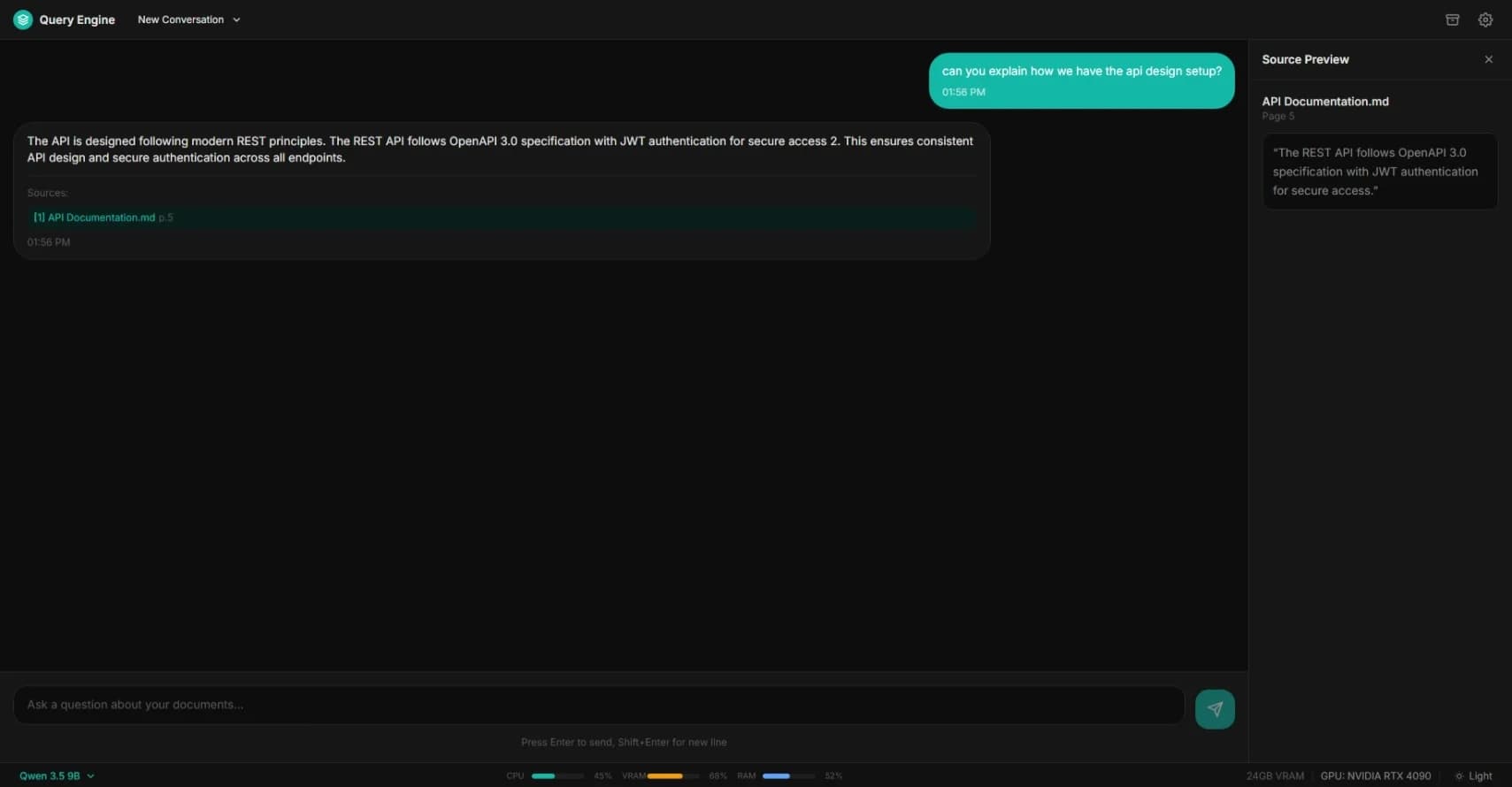
The core user experience is designed around a dynamic split-screen interface where employees interact through a familiar chat-based query system. Users type natural language questions about internal documentation, legal contracts, technical specifications, or procedural guidelines, and the AI generates contextual answers while simultaneously highlighting the exact source paragraph in an integrated document viewer. This dual-panel approach ensures transparency and verification—users can immediately validate AI responses against original source material, building trust in the system's accuracy while reducing hallucination concerns that plague cloud-based AI assistants. The UX philosophy emphasizes instant gratification: sub-second retrieval times mean employees spend less time searching and more time acting on information, transforming document management from a friction point into a competitive advantage.
The content ingestion and data layer handles the complex challenge of processing diverse enterprise document formats at scale. The system supports ingestion of thousands of internal documents spanning PDFs, CAD files, legal briefs, technical specifications, meeting transcripts, and proprietary formatted files. Each document undergoes intelligent chunking to preserve semantic coherence, followed by embedding generation using transformer models optimized for local execution. The ChromaDB vector store maintains these embeddings with associated metadata enabling filtering by document type, date range, department, or custom taxonomies. Incremental ingestion capabilities allow enterprises to add new documents without reprocessing the entire corpus, and the system maintains version history enabling queries against document states at specific points in time. This data architecture transforms static document repositories into living knowledge bases that evolve with organizational needs.
The business model for CogniSearch Enterprise Vault operates through perpetual licensing with optional annual maintenance agreements, aligning with enterprise procurement preferences and avoiding the recurring subscription fatigue common in SaaS offerings. Licensing tiers scale based on concurrent user seats and document processing capacity, with enterprise agreements including dedicated on-premises deployment support, custom integration services for existing document management systems, and priority access to model updates and security patches. The value proposition is straightforward: organizations eliminate the ongoing costs and compliance risks of cloud-based AI solutions while gaining unlimited query capacity without per-token pricing that balloons with enterprise usage patterns. For organizations with existing Microsoft 365 or SharePoint investments, CogniSearch integrates seamlessly as an enhanced search layer without disrupting established workflows.
Data ownership and portability represent core product principles that inform every architectural decision. All embeddings, indexes, and configuration data reside entirely within the enterprise's controlled infrastructure—whether on individual workstations, departmental servers, or air-gapped networks for highly regulated industries. The system generates no telemetry, no usage analytics leave the organization, and there are zero external API calls that could leak sensitive query patterns or document references. The product explicitly excludes cloud sync, mobile companion apps, and browser-based interfaces precisely because these features would undermine the fundamental guarantee of complete data sovereignty. This intentional feature restraint sharpens positioning: CogniSearch is not a general-purpose AI assistant competing with ChatGPT, but rather a specialized tool for enterprises where data security is non-negotiable and existing cloud solutions represent unacceptable compliance risks.
Marketing and acquisition for enterprise software differs significantly from consumer applications, and CogniSearch's landing page and demo environment reflect this reality. The conversion architecture emphasizes proof-of-concept deployments and technical evaluation rather than impulse purchases. Interactive demonstration modules allow prospective clients to experience the query interface with sample sanitized documents, showcasing the split-screen verification workflow and response quality. Technical documentation includes detailed security architecture diagrams, data flow visualizations, and compliance mapping for common regulatory frameworks including SOC 2, HIPAA, and GDPR. The site implements performance optimizations ensuring fast loading of technical assets including model specification sheets, benchmark comparisons, and deployment guides while maintaining accessibility standards for procurement and legal reviewers who evaluate software acquisitions.
Engagement mechanics for enterprise tools center on adoption enablement rather than retention loops common in consumer products. CogniSearch includes built-in usage analytics visible only to administrators, providing insights into query patterns, most-accessed document categories, and peak usage times to inform internal training and rollout strategies. Accessibility standards meet WCAG 2.1 Level AA compliance ensuring employees with disabilities can leverage AI-assisted search capabilities alongside colleagues. The installer and documentation support screen readers, keyboard navigation throughout the interface, and customizable font sizing for readability. SEO strategy targets enterprise technology decision-makers with long-tail content addressing specific compliance scenarios, industry-specific use cases, and competitive comparisons against cloud-based alternatives, with structured data enabling featured snippets for queries about on-premises AI solutions and offline LLM deployment.
The combined result is a coherent enterprise product that addresses a specific, high-stakes problem—enabling AI-powered knowledge retrieval for organizations that cannot use cloud services—through an architecture specifically designed for complete isolation, a user experience optimized for verification and trust, and a business model aligned with enterprise procurement realities. Every component reinforces the core value proposition: enterprise-grade AI search that keeps proprietary knowledge entirely within organizational control while delivering the instant, intelligent retrieval capabilities that modern knowledge workers expect.
By The Numbers
Problem statement
The Challenge
Enterprises possess gigabytes of highly valuable, proprietary knowledge scattered across internal PDFs, CAD files, legal documents, technical specifications, and procedural guidelines accumulated over decades of operations. This institutional knowledge represents a critical competitive asset, yet remains largely inaccessible because traditional search tools cannot understand semantic context or natural language queries.
While AI offers a revolutionary way to instantly search and retrieve insights from this data, corporate compliance and security policies strictly prohibit uploading sensitive company intellectual property to public cloud APIs like OpenAI, Anthropic, or Google. The cost of inaction is substantial: employees waste hours manually searching through documents, institutional knowledge remains siloed within departments, and critical information is frequently missed during time-sensitive decisions.
How we solved it
Our Solution
We developed the CogniSearch Enterprise Vault as a fully localized, offline-first native desktop application that functions as a private AI search engine. The system ingests thousands of internal company documents, converts them into mathematical embeddings using transformer models optimized for local execution, and stores them in a highly optimized local vector database powered by ChromaDB.
We integrated llama.cpp to run a quantized Large Language Model directly on the user's local hardware, enabling sub-second retrieval times without any external network calls. The Retrieval-Augmented Generation pipeline executes entirely offline, guaranteeing absolute data sovereignty and compliance with even the strictest security policies including those governing air-gapped networks in highly regulated industries.
Technical implementation
What Was Built
A fully localized native desktop application built with C#/.NET for Windows with Tauri cross-platform support, integrated llama.cpp quantized Large Language Model inference engine running on consumer-grade hardware, ChromaDB local vector database for semantic embeddings, dynamic split-screen user interface with chat-based query system and integrated document viewer with source highlighting, document ingestion pipeline supporting PDFs, CAD files, legal briefs, and proprietary formats with intelligent chunking and metadata tagging, incremental document ingestion with version history, usage analytics dashboard for administrators, WCAG 2.1 Level AA accessible interface with screen reader and keyboard navigation support, and compliance documentation mapping for SOC 2, HIPAA, and GDPR frameworks.
Impact & outcomes
The Results
Provided employees with an instant, chat-based interface to query complex internal documents with sub-second retrieval times, transforming document management from a friction point into a competitive advantage. The split-screen interface generates AI-powered answers while simultaneously highlighting the exact source paragraph in the original document viewer, enabling immediate verification and building trust in system accuracy. Organizations achieved guaranteed absolute data sovereignty and compliance as the entire RAG pipeline executes with zero internet connectivity required, eliminating the compliance risks and ongoing costs associated with cloud-based AI solutions while gaining unlimited query capacity without per-token pricing.
The Gallery
Hover to expand. Click to view full details.
Ready to Start Your Project?
Let's collaborate to bring your vision to life. Our team is ready to engineer your next digital success story.